
Choose Direct Mail Marketing Services That Fit Your Local Goals
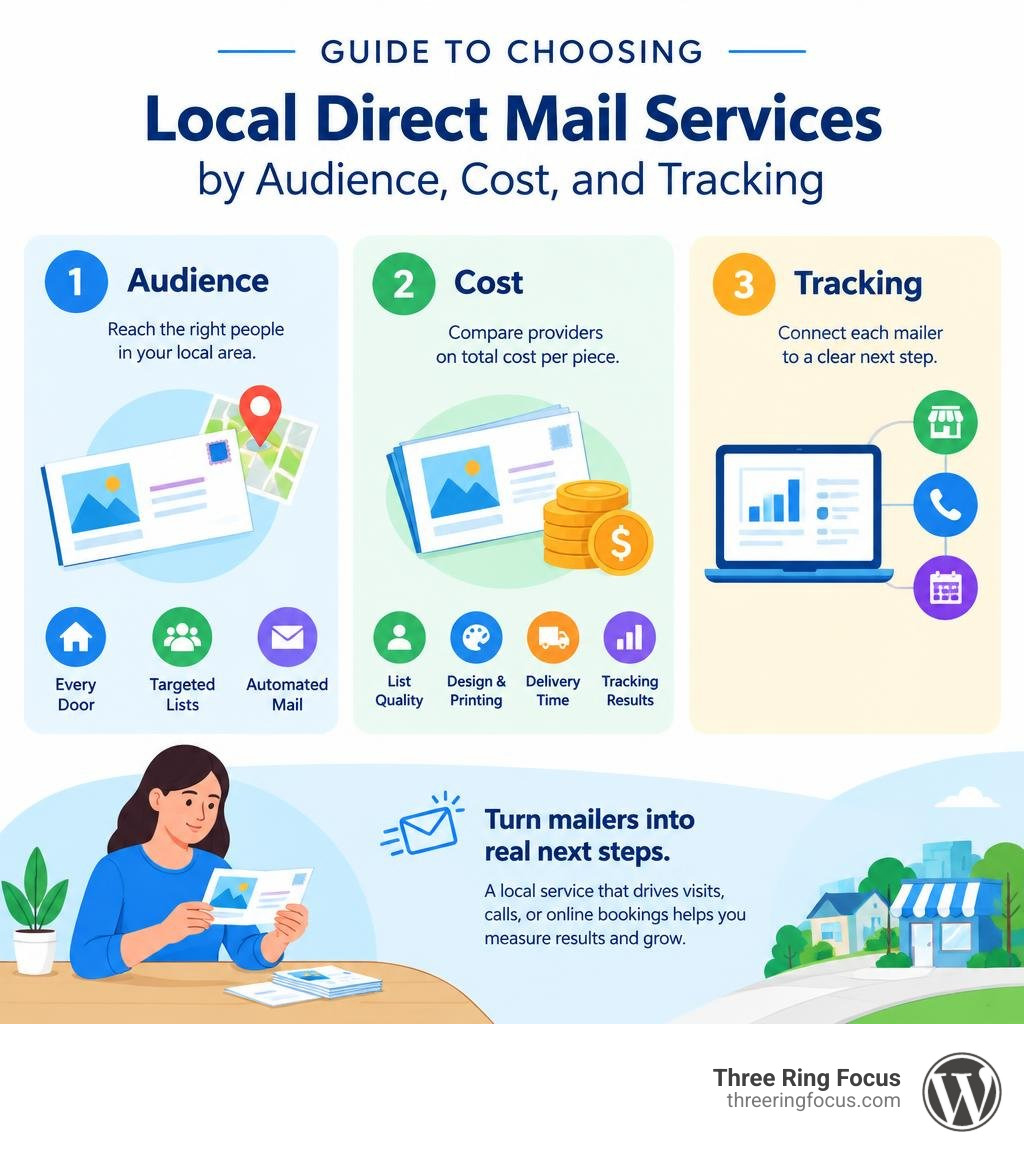
Start with your goal, then choose the service. Use Every Door Direct Mail to reach nearby neighborhoods, targeted mailing lists to reach specific customers, or automated mail to follow up after a customer action. Compare providers on total cost per piece, list quality, design and printing, delivery time, and how they track results.
For a local business, the best fit is a service that can connect each mailer to a clear next step, such as a visit, call, or online booking. That makes print easier to measure alongside your website and digital campaigns.
I’m Luke Wherry, Marketing Director at Three Ring Focus. For more than 17 years, I’ve helped local businesses connect their websites, branding, and digital marketing; that experience shapes how I evaluate direct mail marketing services as part of a wider plan.
Direct mail marketing services word list:
Why Direct Mail Outperforms Digital Channels for Local Outreach
In an era saturated with pop-ups, banner blindness, and crowded email inboxes, physical mail cuts through the digital noise. The average consumer receives hundreds of digital marketing notifications daily, yet their physical mailbox holds only a handful of tangible pieces. That tactile difference creates an immediate psychological connection that digital screens simply cannot replicate.
Industry data confirms the enduring strength of physical outreach. Direct mail achieves a median return on investment of 29%, outpacing paid search at 23% and online display advertising at 16%. When evaluating engagement, direct mail sent to existing customer house files earns an average response rate of 5.3%, while mailings to targeted prospect lists deliver a 2.9% response rate. In contrast, standard email marketing averages an overall response rate of around 0.6%, with typical click-through rates hovering between 2% and 3%.
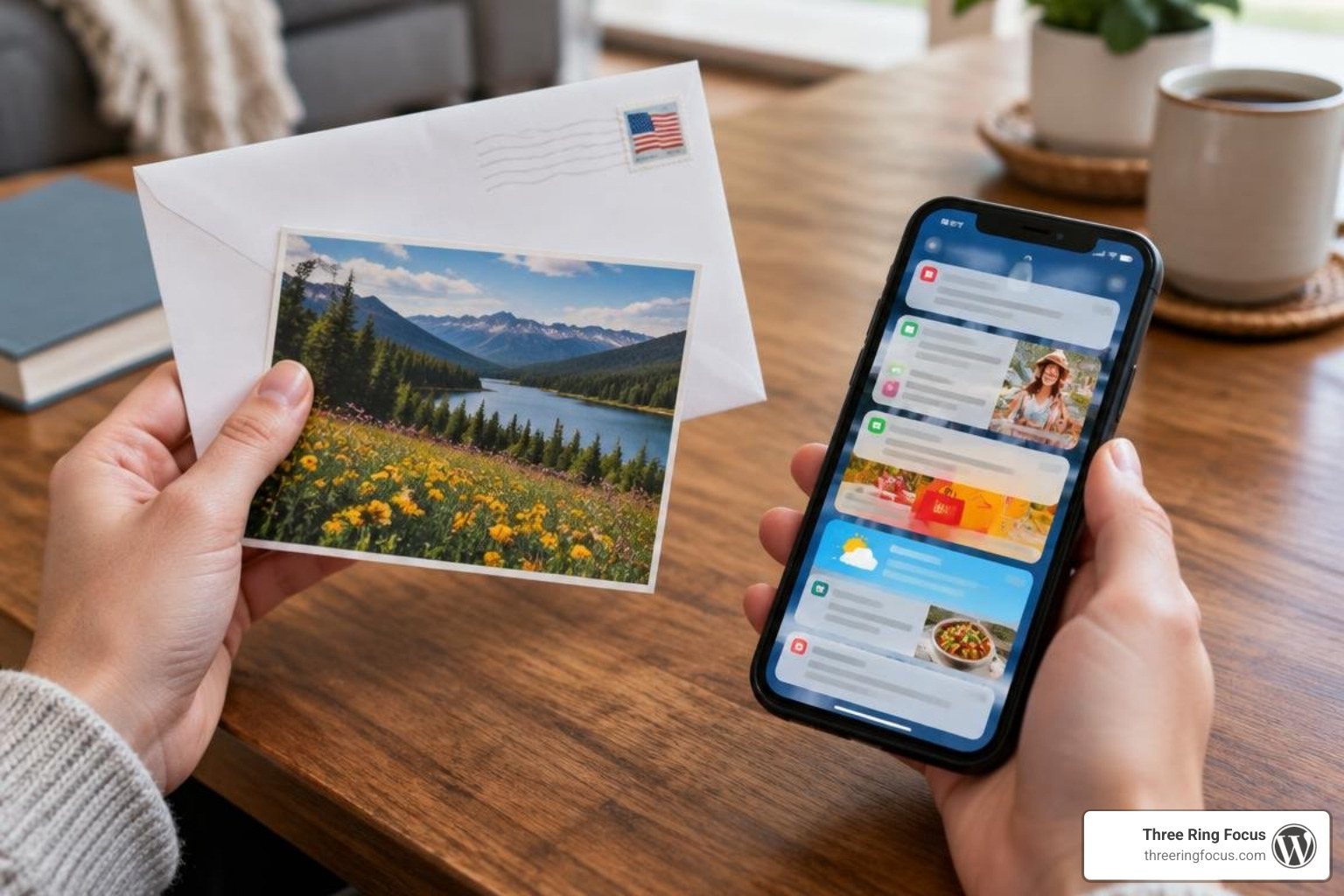
This disparity stems from digital ad fatigue. Prospects can swipe away or delete a digital ad in milliseconds. A well-crafted physical mailpiece, however, lingers on kitchen counters, desks, and refrigerators for days. Combining physical collateral with digital visibility—such as integrating print marketing and local SEO—reinforces your local authority across multiple real-world and online touchpoints.
| Marketing Channel | Median ROI | Average Response Rate (House/Customer) | Average Response Rate (Prospect) | Average Engagement Rate |
|---|---|---|---|---|
| Direct Mail | 29% | 5.3% | 2.9% | Up to 43% response surge over historical baselines |
| Paid Search | 23% | N/A (Click-based) | N/A (Click-based) | 1.5% – 3.5% Avg. CTR |
| Online Display | 16% | N/A (Impression-based) | N/A (Impression-based) | 0.05% – 0.1% Avg. CTR |
| Email Marketing | Variable | ~0.6% | <0.3% | 2.0% – 3.0% Avg. CTR |
Core Types of Direct Mail Marketing Services for Local Growth
Navigating direct mail starts with choosing the right delivery model for your specific campaign goals. Different formats serve different stages of your customer acquisition pipeline.

- Every Door Direct Mail (EDDM): This USPS-backed solution allows businesses to blanket entire postal carrier routes without needing to purchase an address list. It is an ideal, cost-effective vehicle for local restaurants, home service contractors, and retailers wanting to saturate a 3- to 5-mile radius around their brick-and-mortar storefronts.
- Targeted Demographic Mailings: For businesses requiring tighter parameters, list-based mailings leverage refined demographic and psychographic filters. You can pinpoint households by income brackets, homeownership status, credit attributes, age, or presence of children.
- B2B Account-Based Mail: Direct mail is equally potent for business-to-business lead generation. High-impact corporate mailers sent directly to decision-makers bypass digital gatekeepers and establish immediate credibility.
Automated and Trigger-Based Direct Mail Marketing Services
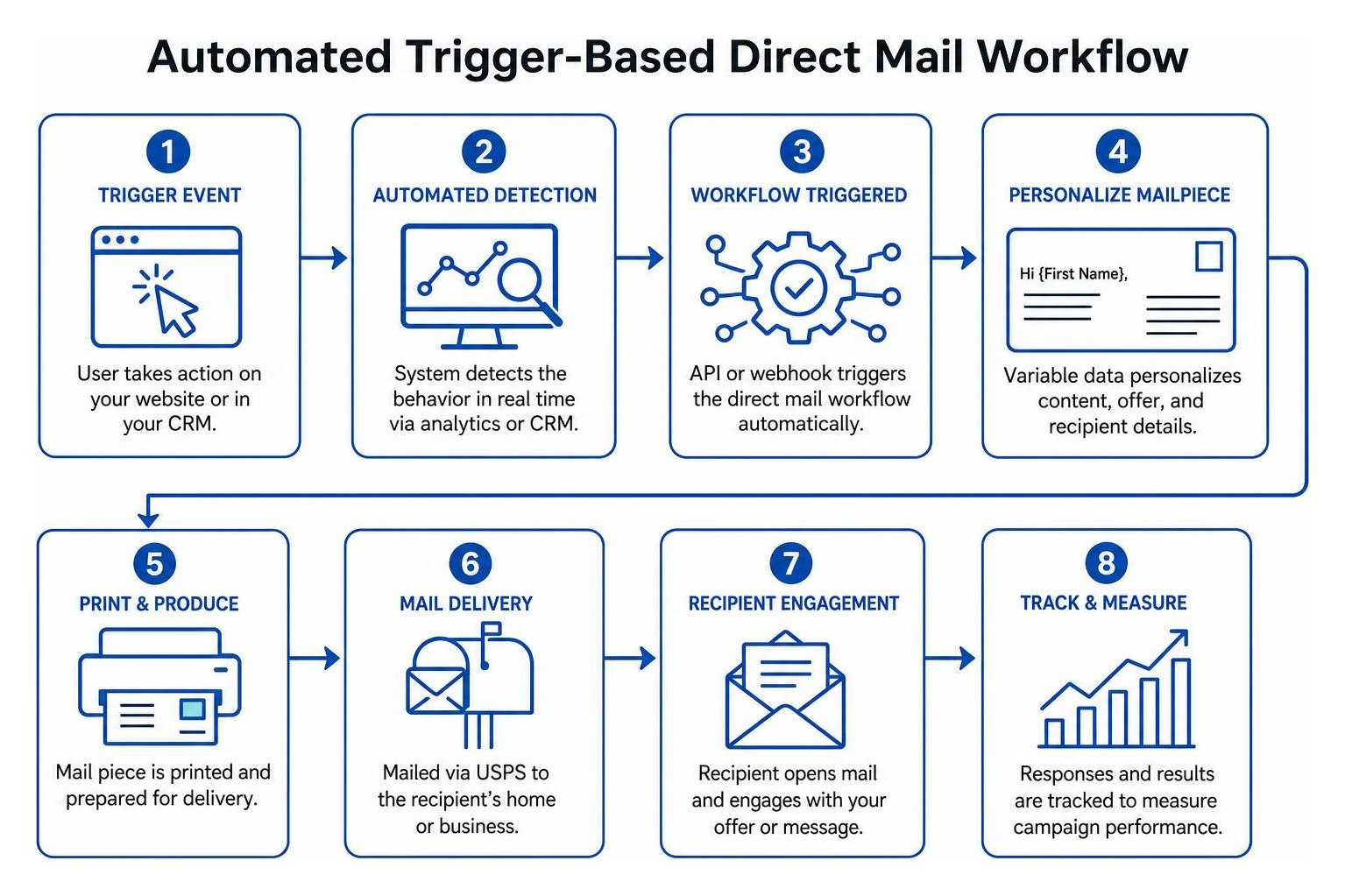
Modern print marketing operates with the precision of digital automation. By connecting printing pipelines to web analytics and customer relationship management (CRM) systems via webhooks and APIs, businesses can trigger physical postcards automatically based on real-time user behavior.
If a website visitor browses a high-intent service page or abandons an online shopping cart, automated print systems can dispatch a personalized promotional mailer within 24 to 48 hours. By utilizing advanced direct mail automation resources, brands replace manual fulfillment with programmatic print workflows that run seamlessly in the background.
Dimensional and Personalized Mail Solutions
Personalization extends far beyond printing a recipient’s first name on a postcard. Variable Data Printing (VDP) allows dynamic customization of images, discount tiers, localized map directions, and even individual sales representative signatures tailored to each recipient.
For high-value prospect outreach, dimensional packages—such as textured mailers, custom boxes, or interactive 3D formats—command near 100% open rates. Integrating sensory finishes, tactile cardstocks, and interactive augmented reality (AR) elements bridges physical touch with interactive digital experiences.
How to Evaluate and Choose the Right Service Provider
Selecting a direct mail partner requires balancing production capabilities, turnaround times, and software compatibility. Look for a full-service provider capable of managing everything from initial strategy and graphic design to data processing, high-volume printing, and postal fulfillment. Aligning your print strategies with a trusted provider of comprehensive marketing services ensures your physical and digital messaging remain cohesive.
Key Features to Look for in Direct Mail Marketing Services
When vetting service providers, confirm they maintain strict data hygiene protocols and modern security credentials:
- National Change of Address (NCOA) Updates: Keeps lists updated with current resident relocations to eliminate wasted postage.
- Coding Accuracy Support System (CASS) Certification: Standardizes and validates addresses against USPS guidelines to guarantee deliverability.
- Data Security & Regulatory Compliance: Providers managing sensitive consumer lists should maintain SOC 2 Type II reports, PCI certifications, and HIPAA compliance where relevant.
- Real-Time Delivery Tracking: Advanced providers supply intelligent mail barcode (IMb) tracking so you know exactly when mailpieces land in prospect mailboxes.
Production Speed, Pricing, and Automation Capabilities
Examine postage options and production timelines. First-Class Mail delivers within 1 to 5 business days, making it ideal for time-sensitive promotions, whereas USPS Marketing Mail (Standard Mail) delivers within 3 to 10 days at a substantially lower per-piece rate.
Furthermore, look for providers who leverage volume discounts and postal incentive programs—such as USPS promotional discounts and growth credits up to 30% for incorporating interactive or sensory print enhancements.
Advanced Campaign Tracking, Design, and MarTech Integration
Direct mail should never operate in an isolated silo. Modern direct mail solutions synchronize with your existing MarTech stack, eliminating manual spreadsheet uploads. In fact, automating manual fulfillment processes can save marketing teams over 40 hours per month.
Digital integration also includes USPS Informed Delivery, which delivers a daily digital preview email to millions of eligible residential consumers. Marketers can attach full-color interactive ride-along images and clickable URLs to these daily preview emails, effectively delivering a digital impression before the physical mailbox is even opened.
Tracking Direct Mail ROI with Digital Mechanisms
Closing the loop between offline distribution and digital conversion is essential for measuring your true return on ad spend:
- Dynamic QR Codes: Provide frictionless, scan-to-mobile access to custom landing pages, pre-populating discount codes automatically.
- Personalized URLs (pURLs): Direct high-value leads to personalized web experiences tailored to their specific account or industry.
- Dedicated Call Tracking Numbers: Assign unique virtual phone numbers to mailpieces to record inbound calls and capture attribution data within your CRM.
- Redemption Coupon Codes: Use specific alpha-numeric discount codes across retail or eCommerce checkouts to monitor exact gross sales generated by the campaign.
Design Best Practices for Maximum Response
Effective print creative commands visual attention and directs the recipient toward a frictionless action step:
- Establish Clear Visual Hierarchy: Craft a strong, benefit-driven headline, supported by concise body copy and high-contrast call-out boxes.
- Focus on a Single Call to Action (CTA): Avoid confusing recipients with competing instructions. Give them one clear, compelling action to complete.
- Invest in Premium Cardstock: Flimsy paper feels like junk mail. Heavyweight 16pt cardstock, soft-touch coatings, or UV gloss finishes signal quality and elevate brand perception.
- Conduct Systematic A/B Testing: Regularly split-test headlines, imagery, value propositions, and format sizes (e.g., standard 4×6 versus oversized 6×11 postcards) to continually optimize cost per acquisition.
Frequently Asked Questions About Direct Mail Marketing
How do direct mail response rates compare to email marketing?
Direct mail routinely outperforms email in raw response rates. Average direct mail response rates range from 2.9% for prospect lists to 5.3% for existing house files, compared to email’s average response rate of approximately 0.6%. While email marketing offers low marginal distribution costs, direct mail delivers significantly higher engagement, visibility, and consumer trust, making it a critical channel for local customer acquisition and retention.
What is direct mail retargeting and how does it work?
Direct mail retargeting identifies anonymous website visitors through privacy-compliant identity resolution networks and matches their digital intent to verified physical postal addresses. When a user browses specific product pages or abandons an online funnel, the system programmatically prints and mails a personalized postcard to their home within 24 to 48 hours, re-engaging the prospect while purchase intent remains high.
How can businesses ensure postal compliance and data security?
To ensure compliance and maximize deliverability, run mailing lists through NCOA and CASS certification software to verify address accuracy and format standards. Ensure designs meet USPS aspect ratios, clear space requirements, and barcode automation guidelines. For data privacy, partner with print and fulfillment facilities that adhere to SOC 2, HIPAA, and PCI standards to protect sensitive customer records.
Conclusion
Direct mail is no longer a static, standalone medium. When executed with modern data segmentation, dynamic personalization, and digital attribution tracking, it serves as a high-performing engine for local business growth. By connecting tangible offline print collateral with your digital funnel, your brand establishes authority that digital ads alone cannot achieve. Discover more about the appeal of print design in a digital world and how integrated creative marketing elevates your local footprint.