How to Win More Nearby Customers
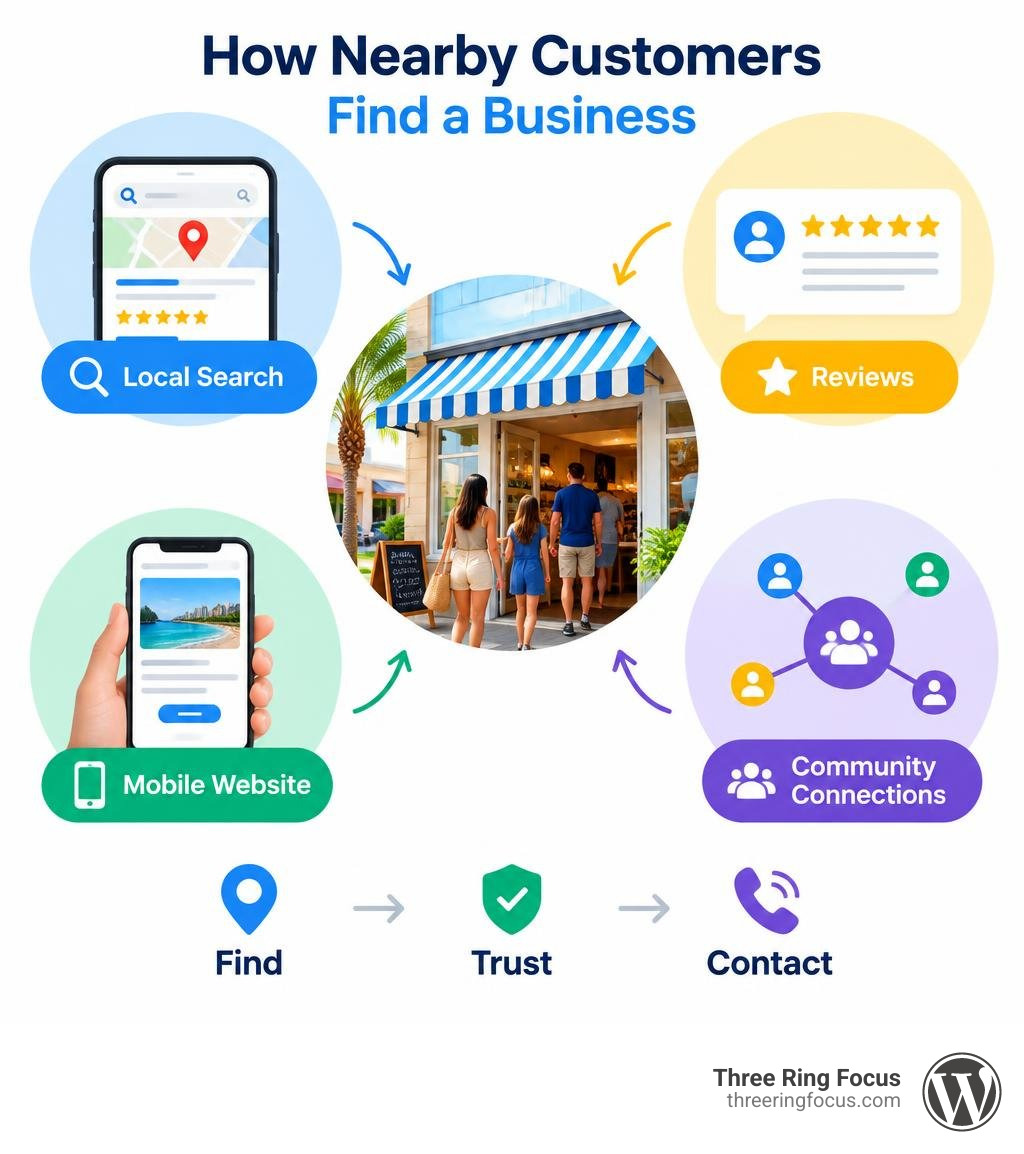
To attract nearby customers, make it easy to find you, trust you, and contact you. Complete your Google Business Profile, keep your hours and contact details consistent, and make your website easy to use on a phone. Then ask happy customers for reviews and track calls and quote requests, not just clicks.
A Myrtle Beach shop can compete with a big brand by being more useful to the person searching right now: show what you offer, where you serve, and how to reach you. No giant budget required. Just a strong local presence that works together across search, your website, and your community.
I’m Luke Wherry, marketing director at Three Ring Focus, and I’ve spent over 17 years helping businesses show up for searches like “local business marketing near me.” Since founding the agency in 2009, I’ve managed SEO, Google Ads, and social campaigns; let’s start with the basics that tie them together.
Building the Core Foundations of Local Business Marketing Near Me
Big national corporations spend millions on broad marketing, but they lack the physical, community-rooted advantage that a local Myrtle Beach company possesses. When a resident or vacationer in the Grand Strand pulls out their phone to search for services, Google doesn’t prioritize a generic corporate headquarters thousands of miles away. The search engine seeks relevant, geographically verified providers right down the street.
To claim those prime positions, you must start with the core technical pillars: your Google Business Profile (GBP), consistent Name, Address, and Phone (NAP) data across directories, and precise local tracking.
A high-performing local profile is not a “set-it-and-forget-it” digital business card. It requires rigorous optimization:
- Primary and Secondary Categories: Select the most precise primary category possible (for example, “HVAC Contractor” rather than simply “Contractor”), followed by supporting secondary categories.
- NAP Consistency: Ensure your business name, street address, and phone number match identically across major aggregators, Yelp, industry directories, and your website footer.
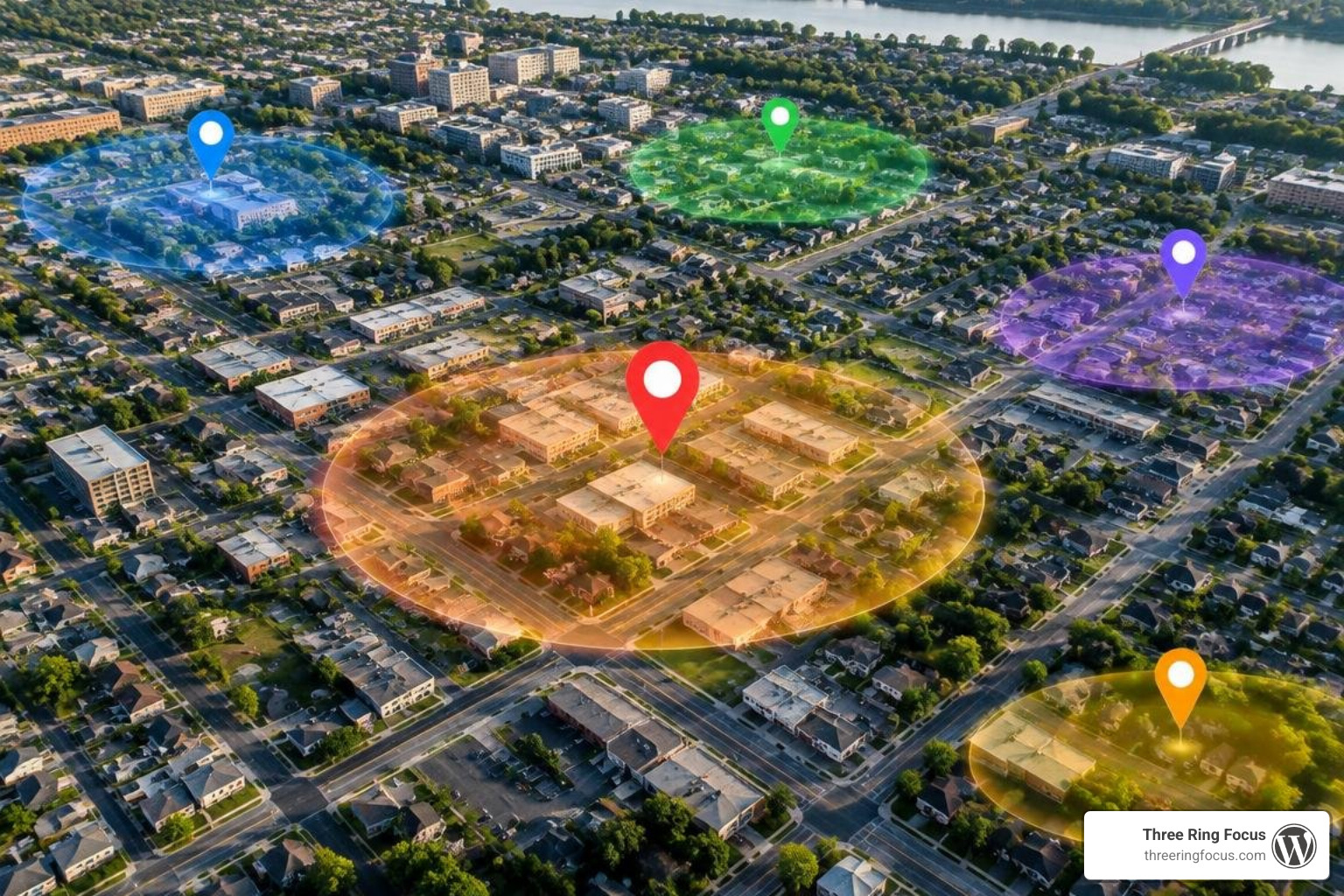
- Geo-Grid Tracking: Monitor your search visibility across a 5×5 or 10-mile radius. A business might rank #1 directly outside its front door in Carolina Forest but drop to position #14 just three miles away in Market Common. Geo-grid mapping reveals these proximity dead zones.
- Hyper-Local Citation Building: Establish structured citations across tier-one data aggregators and local business chambers to reinforce your location authority.
When evaluating external support, partnering with dedicated specialists who understand regional dynamics demonstrates how granular map optimization directly drives inbound calls.
Why Searchers Look for Local Business Marketing Near Me on Mobile
Mobile searches carrying local intent represent over 70% of all neighborhood queries. When someone types or speaks a query on a smartphone, the search engine factors in real-time GPS coordinates rather than general city-wide IP addresses.

Mobile searchers exhibit immediate purchase intent. They are rarely researching theoretical concepts; they are looking for immediate solutions—whether an emergency plumber in Murrells Inlet or a seafood restaurant along Ocean Boulevard. Mobile users expect frictionless engagement:
- Click-to-Call Buttons: Immediate phone dialing without copying and pasting digits.
- Instant Driving Directions: Real-time GPS navigation mapped directly from their current location.
- Clear Operating Hours: Up-to-date regular and holiday hours that prevent frustrating wasted trips.
If your digital presence fails to provide fast, mobile-friendly touchpoints, potential clients bounce to a competitor within seconds.
Turning Daily Marketing Tasks into Reusable Assets
Many business owners get trapped in a cycle of reactive marketing—answering the same customer inquiry forty times a week or scrambling to write social posts from scratch every Tuesday morning. This approach creates endless busyness without generating long-term leverage.
Shift from a task-based mindset to an asset-first methodology:
- Email Response Swipe Files: Instead of writing unique responses to repetitive quote requests, build polished, high-converting email templates that outline your pricing structure, process, and next steps.
- Review Request Templates: Create standardized SMS and email follow-up scripts that your field technicians or front-desk staff can send with a single click.
- Social Media Graphic Kits: Develop branded, reusable Canva or Adobe templates for customer spotlights, seasonal promotions, and educational tips, ensuring brand consistency without redesigning collateral weekly.
- Service Onboarding Guides: Produce downloadable PDF onboarding checklists that educate new clients while establishing your professional authority.
By converting routine actions into permanent collateral, you reduce administrative overhead while delivering a unified customer experience across every touchpoint.
Dominating Hyper-Local Search with Targeted Digital Campaigns
Organic map rankings provide sustainable, long-term leads, but pairing local SEO with hyper-targeted paid campaigns accelerates your market presence. With geo-fencing and postal code targeting, you can concentrate your ad spend strictly on the neighborhoods most likely to convert.
Integrating multi-channel campaigns creates compounding returns for service companies and brick-and-mortar storefronts alike.
| Marketing Channel | Initial Time to Results | Cost Structure | Long-Term Value & Asset Retention | Proximity Sensitivity |
|---|---|---|---|---|
| Organic Map Pack | 45–90 Days | Upfront optimization & ongoing citation maintenance | High; permanent digital asset generating organic calls | Extremely high (tied to physical GPS & local citations) |
| Google Local Service Ads (LSAs) | 1–7 Days | Pay-per-lead | Moderate; stops generating leads the moment budget ceases | High (filtered by designated service areas) |
| Hyper-Local PPC (Google Ads) | Immediate | Pay-per-click | Moderate; quick traffic acquisition for high-intent keywords | Flexible (targeted by zip code, radius, or city) |
| Local Social Ads (Meta) | 1–3 Days | Pay-per-impression / click | Low to Moderate; excellent for local brand awareness | Moderate (targeted by radius and interest demographics) |
Converting Leads from Local Business Marketing Near Me Searches
Generating impressions is meaningless if your digital properties fail to convert searchers into paying clients. High-converting local websites incorporate specific technical elements designed to minimize friction:
- Sub-Two-Second Page Speeds: Fast mobile load times prevent searchers from bouncing back to the search results.
- Prominent Quote Request Forms: Position simple, 3-field contact forms above the fold on mobile screens.
- Local Structured Schema Markup: Implement LocalBusiness and
GeoCoordinatesJSON-LD schema on your website to explicitly communicate your service boundaries, operating hours, and accepted payment types to search engines. - Prominent Trust Badges: Display local chamber memberships, licensing credentials, and real-time customer review ratings adjacent to your primary call-to-action buttons.
Building Automated Review Systems and Reputation Defense
Online reviews serve as the primary social proof mechanism for neighborhood shoppers. A steady stream of authentic, 5-star customer feedback improves both your conversion rates and your organic Map Pack positioning.
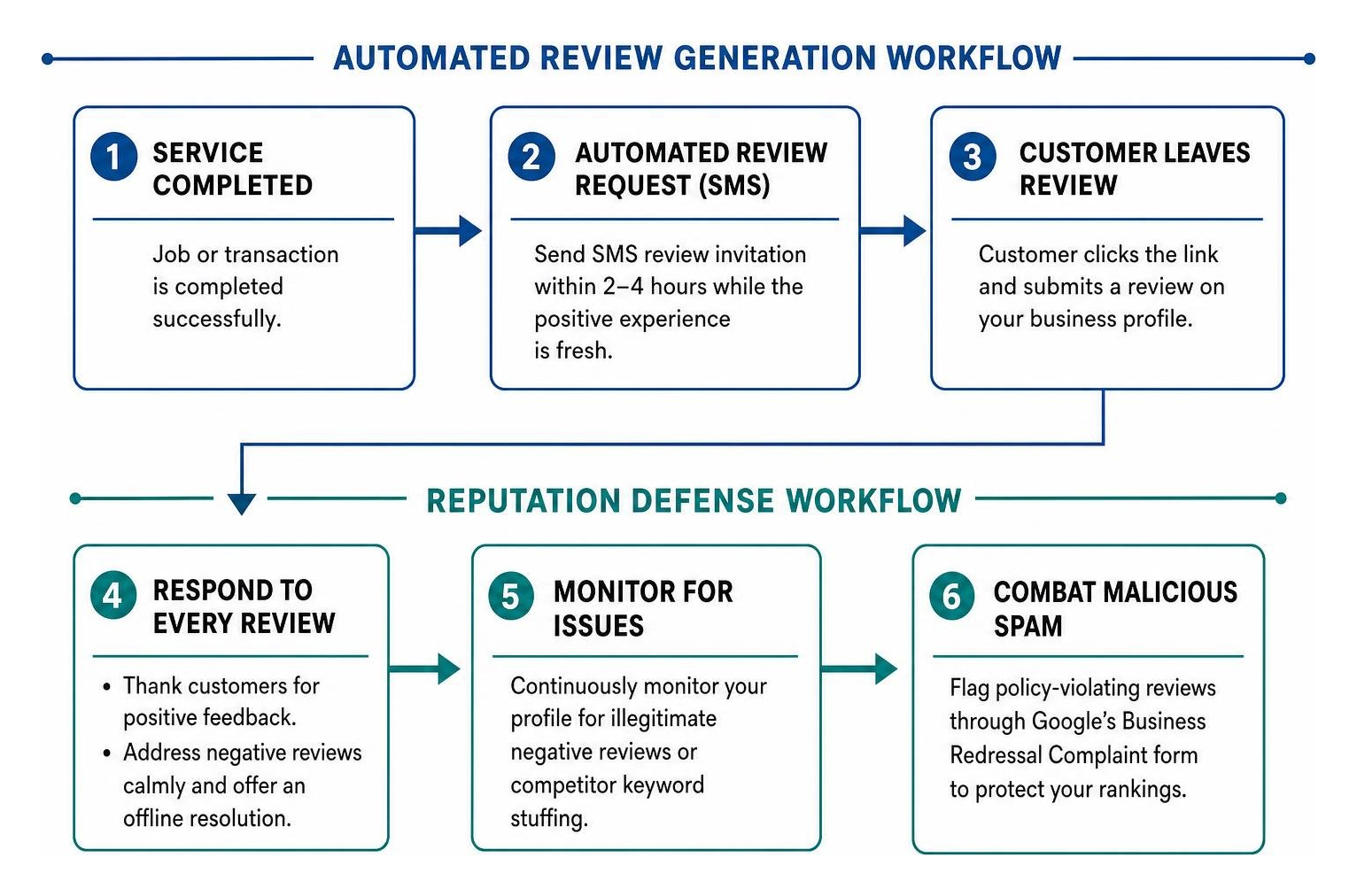
To build a reliable reputation engine:
- Automate Review Requests via SMS: Text messages boast a 98% open rate. Send automated review invitations within 2 to 4 hours of completing a job or transaction while the positive experience remains fresh.
- Respond to Every Review: Craft thoughtful, unique responses to positive feedback (incorporating your service offerings and neighborhood names naturally) and address negative reviews calmly, offering an offline resolution.
- Combat Malicious Spam: Monitor your profile for illegitimate negative reviews or competitor keyword stuffing. Flag policy-violating listings directly through Google’s Business Redressal Complaint form to protect your rankings.
Bridging Physical and Digital Presence Through Community & Print
Digital dominance should not exist in a vacuum. The most resilient local businesses bridge the gap between their online campaigns and their physical, neighborhood presence.
In coastal and close-knit communities like the Grand Strand, local relationships drive organic word-of-mouth momentum that pure digital advertising cannot duplicate. Getting involved with local business chambers, sponsoring youth sports leagues, and forming cross-promotional partnerships with non-competing local vendors grounds your brand in the real world.

Integrating Tangible Print with Local Digital Visibility
Print marketing is far from obsolete; in fact, pairing high-quality tangible collateral with modern digital tracking creates an exceptionally effective hybrid funnel:
- Direct Mail with Dynamic QR Codes: Send targeted mailers to specific subdivisions or commercial parks featuring QR codes that direct recipients to custom, localized landing pages.
- Neighborhood Door Hangers: Service contractors working on a home can place door hangers on neighboring properties offering neighborhood-specific discounts.
- In-Store Signage with Review Prompts: Counter cards featuring scannable review links make it effortless for patrons to leave feedback before walking out the door.
- Tangible Brand Retention: Premium business cards, brochures, and branded vehicle wraps keep your company top-of-mind long after a digital ad disappears from a user’s feed.
Frequently Asked Questions About Local Business Marketing
Why is my business visible on desktop search but invisible on mobile Google Maps?
Mobile search results rely heavily on the searcher’s physical GPS coordinates at the exact moment the query is made. On a desktop computer, Google frequently defaults to a broader geographic service area based on internet service provider routing. If your business profile lacks strong localized proximity signals, dense neighborhood citations, and verified local relevance, Google will display competitors that are physically closer to the user’s mobile device.
How long does it take to rank in the Google Map Pack?
For an established business with existing citations and an active profile, comprehensive optimization can elevate rankings into the top three Map Pack positions within 45 to 60 days. Brand-new businesses, newly created listings, or companies operating in highly competitive industries (such as personal injury law or emergency plumbing) typically require 90 to 120 days of consistent citation building, review acquisition, and on-page location optimization to establish the necessary domain authority.
Do I need a physical storefront to rank in local searches?
You do not need a retail storefront open to the public, but you do need a legitimate, verifiable physical address within your target municipality. Google permits Service Area Businesses (SABs) to hide their residential address while displaying designated service territories. However, attempting to use P.O. boxes, virtual office addresses, or UPS stores violates Google’s guidelines and routinely results in profile suspension.
Conclusion
Outranking national corporate chains does not require matching their multi-million-dollar marketing budgets. By claiming your neighborhood territory through an optimized Google Business Profile, maintaining relentless NAP consistency, deploying automated review systems, and executing targeted local campaigns, you can capture high-intent customers right when they are ready to buy.
Winning your market requires a cohesive, single-source strategy where your website, SEO, paid ads, and physical branding work in perfect sync. To explore how physical marketing collateral elevates your modern digital campaigns, discover the appeal of print design in a digital world and build an integrated marketing engine that dominates your local market today.