
How to Find the Best UI/UX Agency for Your Business
To find the best ui ux agency, look past the pitch deck. Shortlist teams that can show live work for businesses like yours, explain how user research shaped their choices, and give you a clear scope, timeline, and price. Ask how they will test the design and measure whether it helps visitors take action.
A polished mockup is not proof that a website will be easy to use. If a team cannot explain its process or what happens after launch, keep looking.
I’m Luke Wherry, marketing director at Three Ring Focus, where I’ve connected custom, SEO-friendly websites with local business marketing since founding the agency in 2009. That experience shapes how I assess the best ui ux agency: by the work it can show, the questions it asks, and the results it plans to measure.
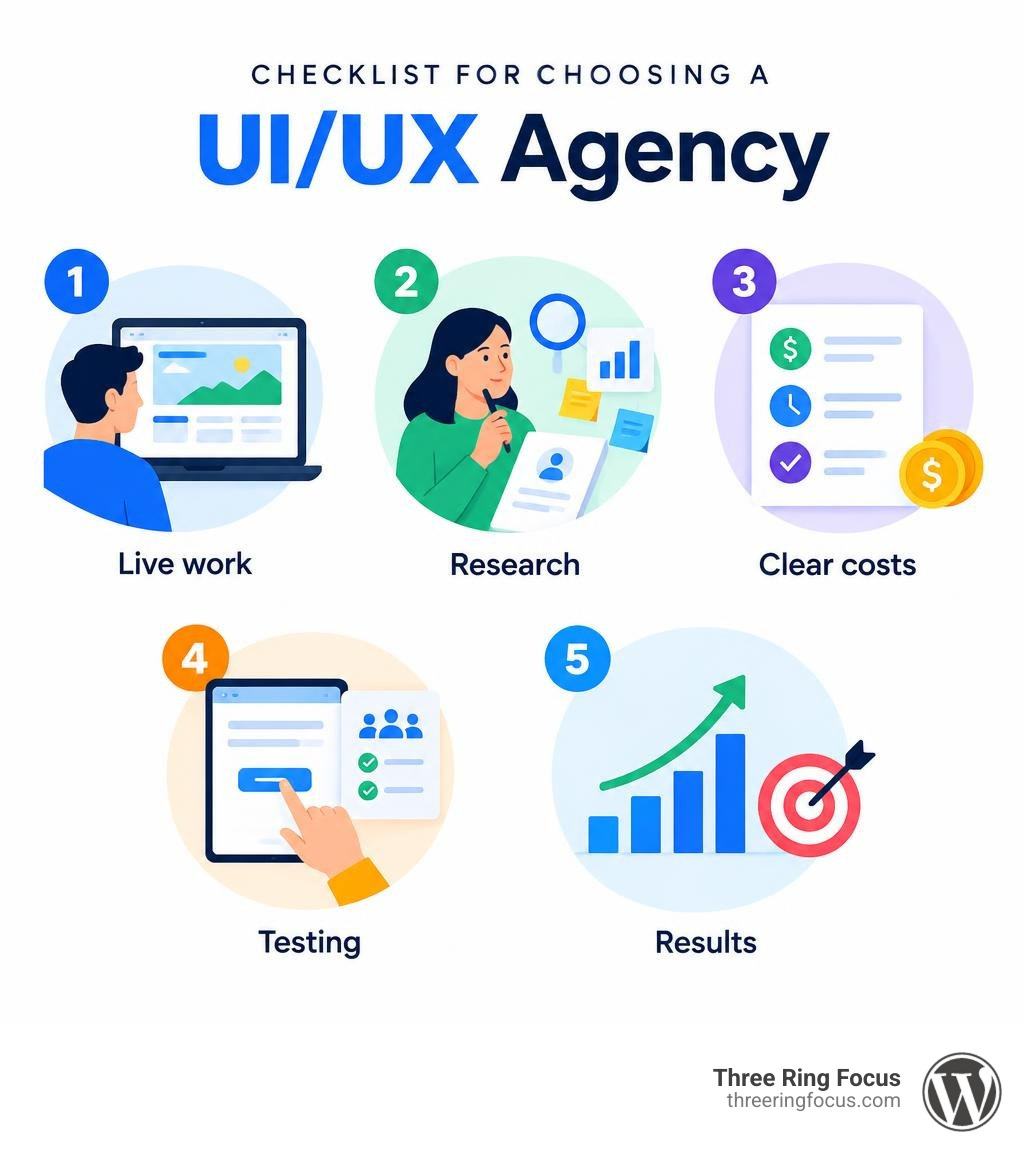
Best ui ux agency terms simplified:
What the Best UI/UX Agency Does Beyond Making Screens Look Good
A great design agency does not simply paint a pretty facade over a broken workflow. While user interface (UI) design focuses on the visual presentation—typography, color palettes, spacing, buttons, and micro-interactions—user experience (UX) design is the architectural backbone. It governs usability, information architecture, site navigation, and user psychology.
When we build a digital product, combining UX/UI ensures that skeletal functionality and aesthetic flair work in total harmony. UX maps the journey so visitors do not get lost, while UI ensures the interface is engaging, intuitive, and visually distinct. Neglecting UX leads to confusion and high bounce rates, while poor UI undermines trust and brand authority.
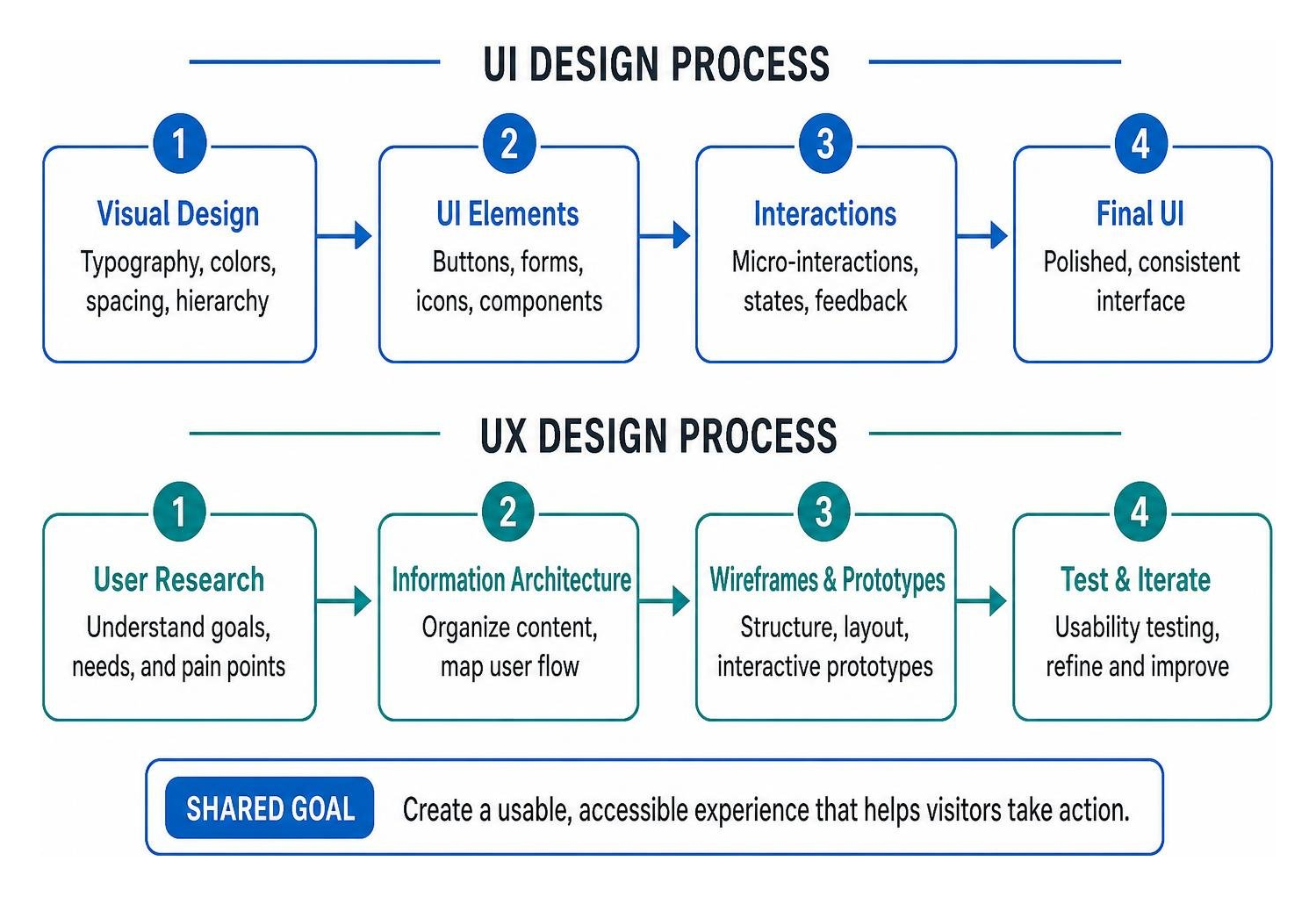
A comprehensive agency creates thoughtful wireframes, runs interactive prototypes, conducts thorough usability testing, and integrates strict accessibility standards (like WCAG and ADA compliance) from the ground up. Adhering to the core principles of usability ensures that every visitor, regardless of device or ability, can complete their intended tasks effortlessly. This level of dedicated user experience design transforms a standard website into a reliable engine for customer acquisition.
How the best UI/UX agency proves user-centered expertise
Real expertise is revealed in how an agency validates decisions. Top agencies do not rely on artistic guesswork; they uncover user needs through systematic research:
- In-Depth User Interviews & Field Studies: Speaking directly with real target users to uncover pain points and hidden expectations.
- User Journey & Empathy Mapping: Charting every step of a customer’s path to identify friction points and eliminate bottlenecks.
- Task Completion & Error Rate Tracking: Measuring how quickly and accurately test participants complete critical tasks during prototype testing.
- Rapid Iteration Sprints: Using feedback from testing rounds to refine layouts before a single line of backend code is written.
- Measurable Business Impact: Linking architectural choices directly to conversion rates, customer retention, and lower support overhead.
How the best UI/UX agency adapts to different project needs
Different digital products demand different design disciplines. A dedicated agency tailors its workflow rather than forcing clients into a rigid template.
Here is how agency specializations map across distinct project types:
- SaaS Product Specialists: Focused on simplifying multi-step onboarding, data-dense dashboards, and modular task flows.
- Enterprise Platform Architects: Handling complex legacy migrations, user permissions, and large-scale administrative tools.
- Startup MVP Builders: Delivering rapid discovery, core feature prioritization, and swift market validation within 4 to 8 weeks.
- Mobile App Experts: Crafting thumb-friendly interaction patterns, offline states, and platform-native gestures for iOS and Android.
- Ecommerce Growth Studios: Optimizing product discoverability, filtered search, and frictionless checkout funnels.
- Healthcare & MedTech Designers: Navigating strict HIPAA compliance, clinical workflows, and error-proof patient interfaces.
- Fintech & Banking Teams: Building trust through clean visual hierarchy, bank-grade data security cues, and rapid transaction confirmation.
- AI & Intelligent Product Innovators: Structuring variable output states, agentic workflows, and user-override autonomy controls.
- Design System Engineers: Creating reusable component libraries and tokenized style guides that streamline future development.
- Brand-Led Digital Agencies: Merging emotional visual storytelling and marketing-driven landing pages with rock-solid underlying UX.
How to Choose the Best UI/UX Agency for Your Project
Shortlisting candidates requires looking beyond fancy presentation decks. You can begin exploring platforms like The Manifest’s UX agency directory or Sortlist’s 2026 UX/UI agency directory to get a broad view of verified firms, project sizes, and client ratings.
However, the real vetting happens when you examine their actual shipped products, scrutinize their development handoff process, and evaluate their day-to-day communication standards.
What the best UI/UX agency should show in its portfolio
When reviewing past work, ask for proof of execution:
- Live, Shipped Products: Open live websites or mobile apps and attempt a real user task. Flashy Figma mockups on social media often hide fatal usability flaws that break in production.
- Relevant User Demographics: Check if the agency has built tools for audiences with similar complexity or technical literacy to your own customers.
- Real Project Constraints: High-performing agencies openly explain the technical, budgetary, and timeline limitations they faced and how they solved them.
- Before-and-After Metrics: Look for quantifiable results, such as a 40% reduction in cart abandonment or a 25% increase in lead generation forms.
- Clean Development Handoff: Ask to see design system documentation, component states, and responsive token libraries prepared for engineers.
What the best UI/UX agency should clarify before the pitch
Before any contracts are signed, a transparent agency will clearly define the working relationship:
- Project Scope and Deliverables: Exact specifications for wireframes, clickable prototypes, style guides, and handoff assets.
- Senior Team Allocation: Confirmation that the senior practitioners pitching your project will actually execute the work rather than passing it to junior contractors.
- Sprint Cadence & Feedback Cycles: Defined schedules for weekly check-ins, asynchronous design reviews, and formal stakeholder sign-offs.
- IP and Research Data Ownership: Complete client ownership of all raw interview recordings, research synthesis, design files, and production assets.
- Accountability & Timeliness: Proven track records of on-time delivery without unexpected budget creep.
Questions to ask before signing
Take these questions into your vetting calls:
- “Can you walk us through three structural design choices that were driven directly by user research rather than personal preference?”
- “How do you conduct usability tests, and will our team have the opportunity to observe live user sessions?”
- “Who will be our direct daily contact, and what collaboration tools (Slack, Jira, Figma) do you use during active sprints?”
- “What specific criteria determine when a design is fully ready for developer handoff?”
- “What post-launch measurement support do you provide to validate design performance against our baseline metrics?”
UI/UX Agency Costs, Value for Money, and 2026 Trends
UI/UX design pricing is shaped by project complexity, research depth, and agency structure. Most agencies operate on one of three engagement models:
| Pricing Model | Best For | Typical Range (2026) | Key Advantage |
|---|---|---|---|
| Fixed-Price | Clearly defined scopes, specific MVPs, or redesigns | $10,000 – $80,000+ | Predictable budget and locked milestone deliverables |
| Hourly / Time & Materials | Evolving products, iterative sprints, flexible scopes | $75 – $200+/hour | Complete flexibility to pivot requirements mid-project |
| Monthly Retainer | Continuous product optimization, embedded support | $5,000 – $20,000+/month | Dedicated ongoing capacity without per-project contract friction |

Typical project cost and timeline ranges
- Small Builds & Focused Redesigns ($10,000 – $30,000 | 8–14 Weeks): Ideal for brand websites, simple SaaS marketing platforms, or targeted landing page overhauls that require structured wireframing and modern UI.
- Mid-Tier Product Engagements ($30,000 – $80,000 | 12–18 Weeks): Standard for complete web applications, comprehensive ecommerce overhauls, or mobile apps requiring full user research, iterative prototyping, and custom design systems.
- Complex Enterprise Systems ($80,000 – $250,000+ | 16–26+ Weeks): Necessary for multi-sided platforms, regulated health/fintech applications, or massive multi-tier software suites requiring deep discovery and hundreds of unique interface states.
How to judge value beyond the lowest quote
Choosing an agency purely on the lowest bid often leads to hidden costs down the line. Cheap quotes frequently exclude user research, skim over error states, and deliver unorganized Figma files that confuse your developers.
True value is judged by total return on investment:
- A well-structured design system saves hundreds of engineering hours during future updates.
- Intuitive self-service workflows significantly lower customer support ticket volumes.
- Frictionless checkouts directly increase conversion rates and average order values.
- Upfront clarity prevents scope creep and costly mid-development rebuilds.
Trends shaping agency services in 2026
The design landscape in 2026 is evolving rapidly. Agencies are moving far beyond static responsive grids to build intelligent, context-aware platforms.
- Agentic Workflows and Autonomy Cues: As software takes on multi-step tasks autonomously, interfaces must provide clear visibility, status feedback, and frictionless manual override controls.
- Variable Outputs & Generative UI: Designing interfaces that dynamically reconfigure their layouts, forms, and data visualizations based on real-time user intent and AI output confidence levels.
- Prototyping with Live Models: Replacing static click-through mockups with functional, code-level prototypes connected directly to live data pipelines to test actual system latency and behavior.
- Design Systems for Scalability: Unifying marketing sites, client portals, and mobile apps under centralized token architectures.
- Accessibility as a Core Baseline: Treating universal accessibility not as an afterthought, but as an essential standard for search ranking and user retention. To see how custom architecture outpaces generic themes in these areas, compare custom web design vs. online templates and explore modern responsive web design.
Frequently Asked Questions About UI/UX Agencies
Do businesses need both UI and UX design?
Yes. UI and UX are two sides of the same coin. UX design ensures your digital product solves the user’s problem logically, while UI design ensures the experience is clear, on-brand, and intuitive to navigate. A product with fantastic UX but terrible UI feels clunky and untrustworthy. A product with gorgeous UI but broken UX looks stunning right up until the user gives up in frustration.
How can a business measure the results of a UI/UX project?
Track key behavioral metrics before and after the redesign launches:
- Conversion Rate: The percentage of visitors completing primary goals (purchases, form fills, sign-ups).
- Task Success Rate & Completion Time: How effortlessly users navigate critical workflows without errors.
- Customer Support Volume: Reductions in support tickets related to confusion, checkout issues, or onboarding friction.
- Retention and Churn Rates: Whether the refined experience encourages repeat visits and higher customer lifetime value.
Should a company hire a local agency or work remotely?
It depends on your business model. For software companies targeting global users, a remote agency with deep specialization in your vertical is often ideal. However, for regional companies and local businesses, partnering with an experienced agency that understands your regional market dynamics, customer demographics, and local SEO landscape provides a distinct competitive advantage.
Conclusion
Finding the right design partner comes down to alignment, transparency, and proven capability. Shortlist agencies based on their shipped products, validate their user research practices, and demand clear proposals with realistic timelines. The right agency will act as a true extension of your business, turning complex user challenges into intuitive digital experiences that drive measurable revenue growth.
If you are looking for a partner that seamlessly unifies user experience design with high-impact digital strategy, explore how our team delivers integrated web design and marketing support to help your business stand out and grow.