What Bespoke Website Design Means for Your Business
Bespoke website design means shaping a website around your business goals, customers, and brand instead of fitting them into a ready-made template. It can give you more control over how people find information, contact you, book a service, or buy. It is most useful when a template cannot support the experience or features you need.
That does not mean every local business needs a fully custom build. The right choice depends on your budget, the work your site must do, and how you expect it to grow.
I’m Luke Wherry, Marketing Director at Three Ring Focus. For over 17 years, I’ve worked on SEO-friendly websites and connected marketing for local businesses; this guide will help you decide where bespoke website design is worth the investment.
Defining Bespoke Website Design and Core Business Value
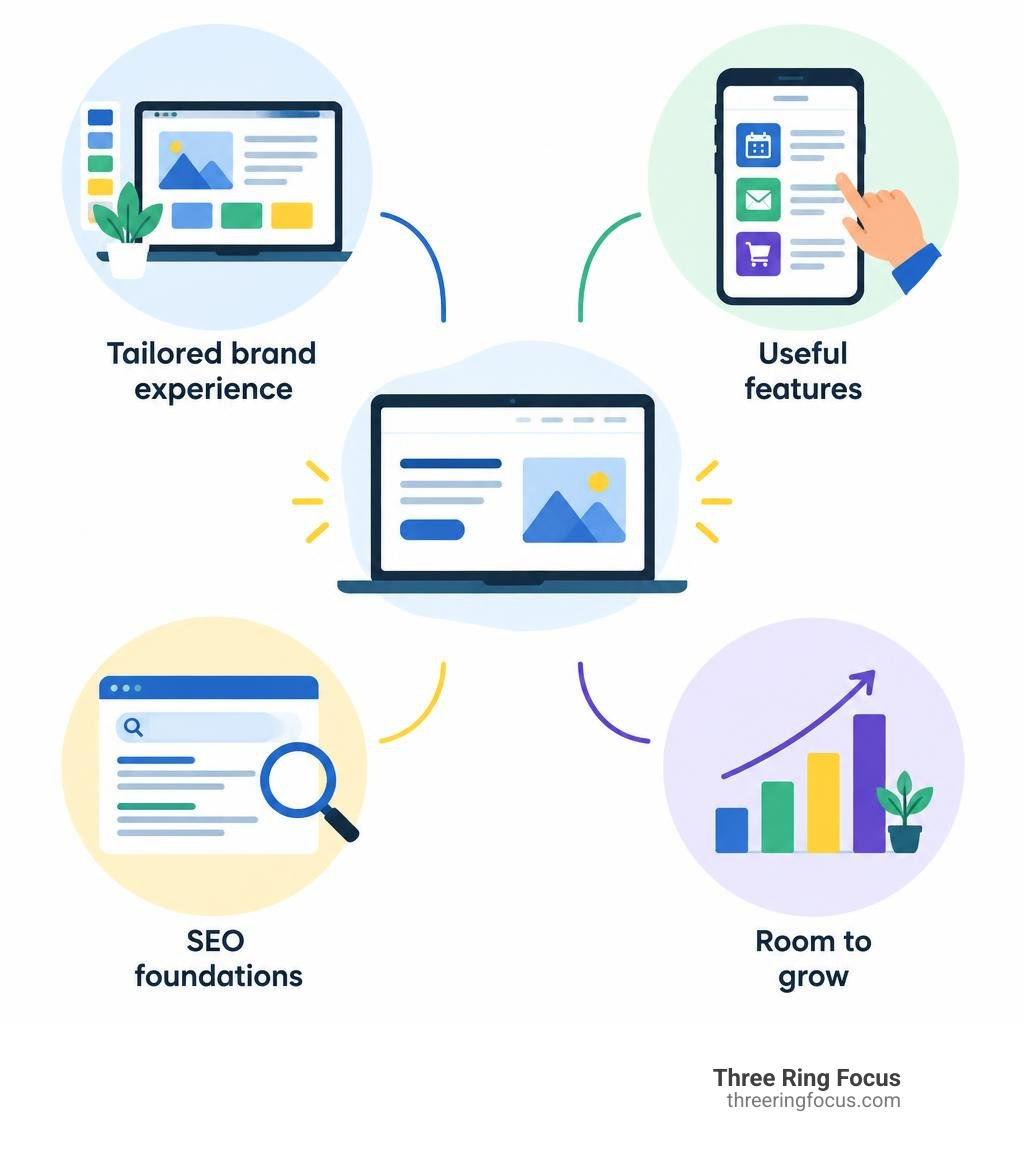
At its core, a bespoke build is an intentional piece of digital architecture. Instead of installing a pre-packaged theme bundled with hundreds of features you will never touch, custom design begins with an empty canvas and your specific business goals.
When you invest in tailor-made development, every line of markup, stylesheet rule, and script serves a deliberate purpose. This standard of code cleanliness directly impacts how search engines crawl your content, how quickly your pages render on handheld devices, and how seamlessly prospective clients move through your sales funnel. Rather than settling for a digital storefront that looks identical to a competitor down the street, custom web architecture creates unmistakable brand differentiation.
Custom builds also unlock frictionless API integrations. Whether you need your site to communicate directly with a proprietary warehouse database, dynamic scheduling software, or a central CRM, tailored development builds those bridges natively without relying on fragile, third-party connector plugins that break during routine platform updates.
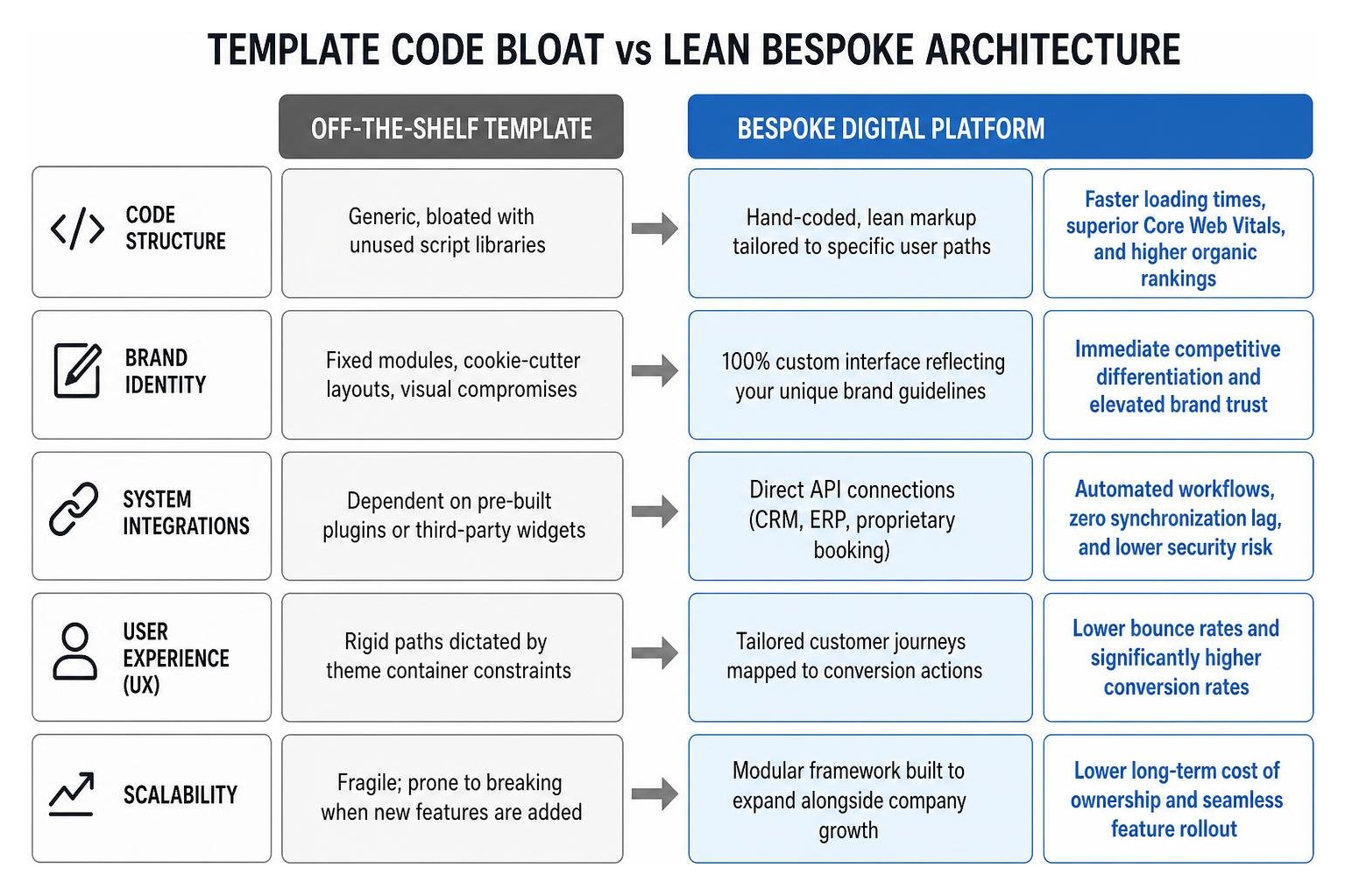
| Feature / Architecture | Off-the-Shelf Template | Bespoke Digital Platform | Strategic Business Impact |
|---|---|---|---|
| Code Structure | Generic, bloated with unused script libraries | Hand-coded, lean markup tailored to specific user paths | Faster loading times, superior Core Web Vitals, and higher organic rankings |
| Brand Identity | Fixed modules, cookie-cutter layouts, visual compromises | 100% custom interface reflecting your unique brand guidelines | Immediate competitive differentiation and elevated brand trust |
| System Integrations | Dependent on pre-built plugins or third-party widgets | Direct API connections (CRM, ERP, proprietary booking) | Automated workflows, zero synchronization lag, and lower security risk |
| User Experience (UX) | Rigid paths dictated by theme container constraints | Tailored customer journeys mapped to conversion actions | Lower bounce rates and significantly higher conversion rates |
| Scalability | Fragile; prone to breaking when new features are added | Modular framework built to expand alongside company growth | Lower long-term cost of ownership and seamless feature rollout |
What Sets Bespoke Website Design Apart from Cookie-Cutter Themes
Many businesses start out using DIY platforms or budget themes. In the early stages, that makes sense. However, as an organization expands, the structural cracks of cookie-cutter themes quickly emerge. Pre-made themes must cater to thousands of different buyers simultaneously, meaning their codebases are naturally bloated with excessive CSS, unused JavaScript libraries, and convoluted page builders.
This hidden bloat destroys page speed and hurts your Core Web Vitals—benchmarks search engines use to evaluate user experience. A site bogged down by heavy plugins frustrates visitors and drives down your conversion rate. When analyzing custom web design vs online templates, the real cost of a generic theme often hides in lost leads and sluggish performance.
Partnering with an experienced team ensures your technical foundation is built for speed and long-term search visibility. If you have ever wondered why you need a professional web designer, the answer lies in execution: skilled professionals craft a lean, responsive engine tuned specifically for conversions, rather than assembling a digital patchwork quilt.
Scalability and Technical Extensibility
A website should never be a static project you launch and forget; it is a living revenue channel. As your business grows, your digital platform must adapt without requiring a complete teardown every two years.
Custom builds provide robust technical extensibility through tailor-made content management solutions (CMS). Instead of navigating a cluttered back-end filled with settings you never use, your team receives an intuitive editorial environment structured around your everyday workflow. Adding a new case study, publishing regional service pages, or updating product specifications takes seconds.
Furthermore, bespoke design facilitates enterprise-level scalability. Connecting custom ERP connectors or building automated pipeline updates with your CRM removes hours of manual data entry. Whether your expansion involves launching multi-location directories, multi-currency checkout systems, or client portals, a tailored foundation gives you total freedom to grow.
The Strategic Process Behind Bespoke Website Design
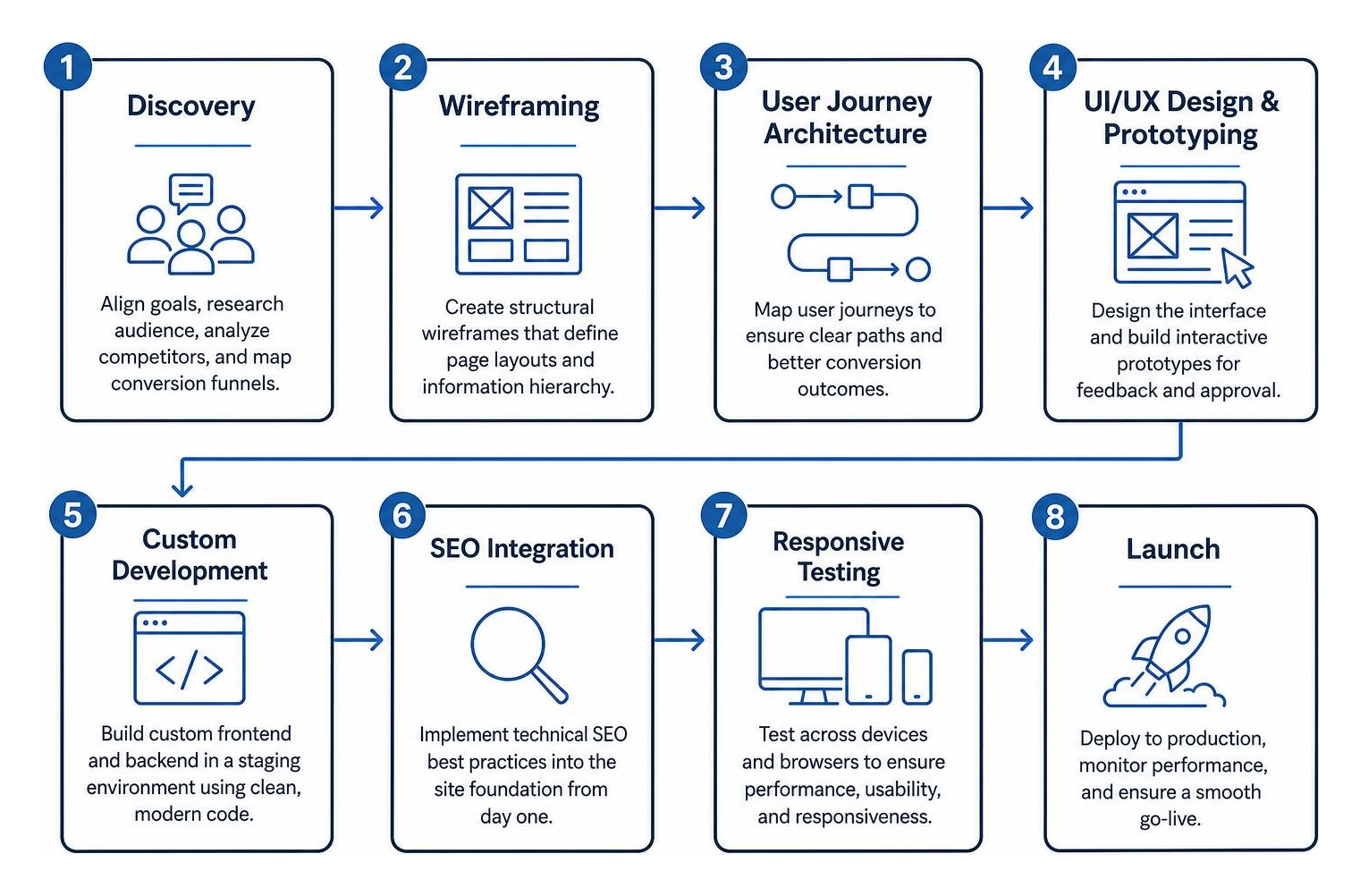
Crafting a tailored digital platform is a structured engineering process. It requires careful research, strategic planning, creative UX prototyping, and rigorous technical validation.

Discovery, Wireframing, and User Journey Architecture
Great design starts long before writing code. The discovery phase aligns stakeholder goals with actual audience behaviors. During this stage, we dive deep into your target market, uncover user pain points, analyze competitors, and map out your conversion funnels.
We then translate these insights into structural wireframes and interactive prototypes. This blueprinting phase focuses exclusively on user journey mapping—ensuring that every visitor, whether browsing on a smartphone or a desktop monitor, finds the information they need within seconds. Knowing the difference between a pretty website and a successful one comes down to this structural clarity: aesthetics capture attention, but deliberate UX architecture drives inquiries and sales.
Custom Development, SEO Integration, and Responsive Testing
Once the interface layouts are approved, development begins in a dedicated staging environment. Rather than relying on generic site generators, custom development uses semantic HTML5, modern CSS architectures, and clean JavaScript to deliver instantaneous load speeds.
Technical search engine optimization is baked directly into the site’s foundation from day one. This includes:
- Structured Data & Schema Markup: Giving search engines detailed context about your local business, products, services, and client reviews.
- Semantic Hierarchy: Ensuring proper nesting of headings, landmark roles, and accessible navigation patterns.
- Asset Optimization: Delivering modern image formats (such as WebP and AVIF) with responsive srcset attributes to save mobile bandwidth.
Because mobile devices account for the majority of global web traffic, implementing flawless responsive web design is essential. Every custom layout undergoes thorough cross-browser and multi-device testing to guarantee that animations, navigation menus, and interactive forms function smoothly across all screen sizes.
Evaluating Costs, ROI, and Platform Selection for Growing Brands
Evaluating a custom web build requires looking beyond the initial invoice to understand total cost of ownership (TCO). A cheap template often incurs recurring expenses through premium plugin licenses, emergency developer bug fixes, and missed sales opportunities caused by slow load speeds.
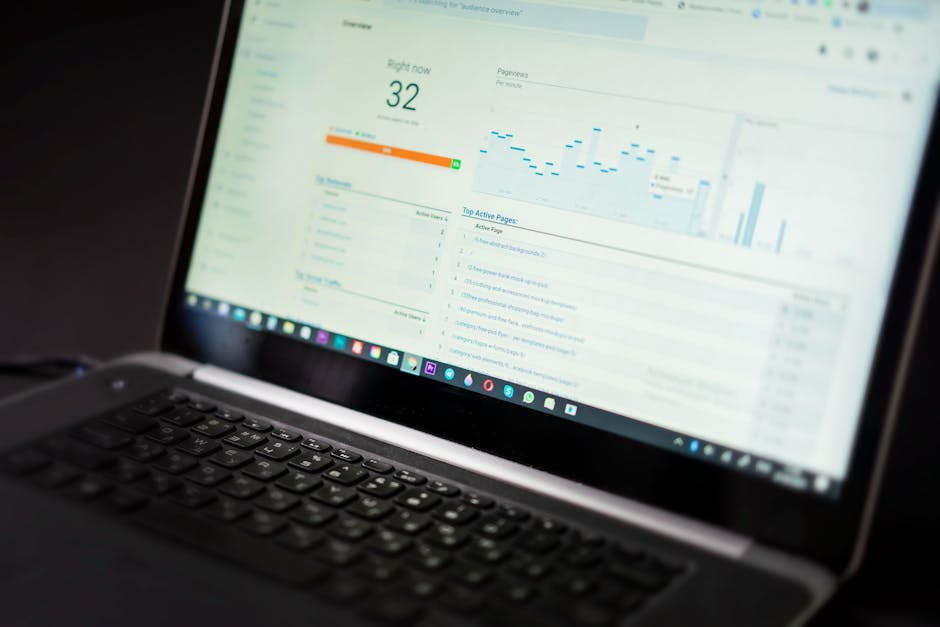
When weighing a custom website or DIY builders, companies that depend on consistent lead generation usually find that tailored solutions deliver a much higher return on investment. A high-performing digital platform works 24/7 as an automated sales engine, converting casual searchers into paying clients.
Budgeting Factors and Realistic Timelines
The investment required for a bespoke site depends on several core variables:
- Information Architecture & Page Scope: A targeted 8-page lead generation site requires different design and development resources than a 50-page enterprise portal.
- E-Commerce & Transaction Logic: Custom checkout paths, subscription logic, and dynamic filtering increase scope compared to standard informational layouts.
- Third-Party API Integrations: Connecting custom booking engines, property databases, or private client dashboards requires dedicated back-end programming.
- Content Production & Asset Creation: Professional copywriting, custom illustrations, and motion graphics enhance engagement but affect the overall budget.
A typical bespoke project spans 4 to 8 weeks from initial discovery to public launch, structured across focused development sprints:
- Weeks 1–2: Discovery, brand strategy, user journey mapping, and wireframing.
- Weeks 3–4: High-fidelity UI design, component systems, and design approvals.
- Weeks 5–6: Front-end and back-end custom coding, CMS configuration, and API integration.
- Weeks 7–8: Quality assurance, cross-device testing, SEO validation, and deployment.
Maintenance, Hosting Security, and Ongoing Optimization
Launching your website is only the first step. Protecting your investment requires dependable infrastructure, active security monitoring, and continuous conversion rate optimization.
Standard off-the-shelf templates and plugins are common targets for automated security bots. A custom-engineered platform dramatically shrinks your attack surface by eliminating unnecessary third-party scripts. Pairing clean code with enterprise-grade hosting, automated daily backups, modern SSL encryption, and routine speed audits ensures your site remains secure and reliable. Ongoing optimization turns your platform into a durable commercial asset that consistently outperforms the competition.
Frequently Asked Questions About Bespoke Website Design
How long does a full bespoke build typically take?
Most tailored website projects take between 4 and 8 weeks from kickoff to deployment. Smaller, focused marketing builds can launch within four to six weeks, while complex websites featuring bespoke eCommerce logic, custom database queries, or advanced API integrations may require eight weeks or more. This timeframe ensures complete discovery, hand-crafted coding, thorough cross-browser testing, and careful SEO setup.
Can AI tools like ChatGPT design a custom website?
While modern AI tools excel at brainstorming copy, drafting basic code snippets, and diagnosing syntax errors, they cannot replace human-led digital strategy. AI models lack the business intuition needed to analyze your unique local market, understand complex buyer psychology, or engineer a cohesive brand identity. A successful custom website blends clean technical architecture with brand strategy—an integrated discipline that requires experienced human designers and developers.
Is a custom website worth the investment for a growing business?
Yes. If your current website feels slow, fails to reflect your brand’s true quality, or limits your ability to add custom features, a bespoke build is one of the highest-leverage investments you can make. It removes recurring plugin fees, avoids template performance bottlenecks, and provides an optimized user journey that turns more visitors into qualified leads.
Conclusion
Your website is the centerpiece of your modern digital marketing strategy. While off-the-shelf templates and DIY builders offer a quick way to establish a basic web presence, growing brands eventually outgrow their rigid constraints.
Investing in custom web architecture provides complete creative freedom, enterprise-level security, lightning-fast load times, and effortless scalability. At Three Ring Focus, we deliver full-spectrum digital solutions—blending marketable, search-engine-optimized websites with complete branding and performance marketing. If you are ready to build a digital platform that sets your company apart, reach out to our team at a dedicated web design company and partner with a leading digital team to start building your custom solution today.