Understanding the Mechanics: CMS Platforms vs Custom Development
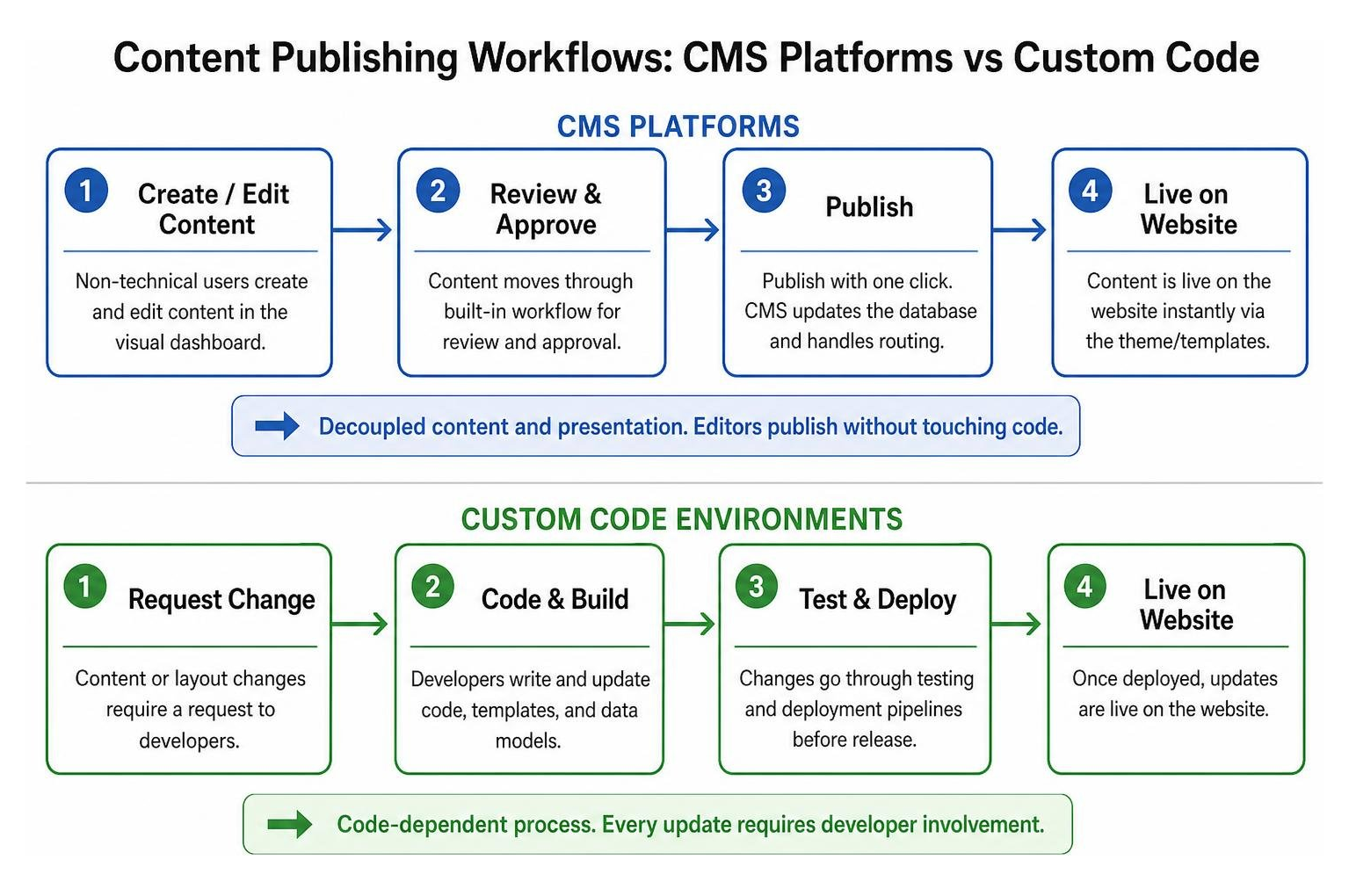
When planning a new web build, the fundamental choice comes down to how content relates to code. Choose a CMS when you need rapid launch timelines, lower setup costs, and non-technical editorial control over pages, posts, and media. Choose custom development when your project requires bespoke software logic, proprietary workflows, or specialized database architectures that off-the-shelf platforms cannot accommodate. A content management system (CMS) decouples the presentation layer from the underlying database, allowing non-technical team members to manage content without touching source files. Custom development, by contrast, builds every route, data model, and user interface component from scratch using bespoke application logic.
| Decision Factor | CMS Platforms | Custom Development |
|---|---|---|
| Initial Investment | Lower to moderate setup costs | Higher initial engineering investment |
| Deployment Speed | Rapid rollout using pre-built modules | Longer development cycles from scratch |
| Maintenance Overhead | Managed core, theme, and plugin updates | Dedicated developer time for dependencies |
| Design & Logic Flexibility | High via themes; bound by system architecture | Unlimited freedom for custom workflows |
| Content Autonomy | Immediate editing via visual dashboards | Requires developer involvement for structural changes |
| Code Base Complexity | Standardized file structures across sites | Bespoke code ownership requiring detailed documentation |
Choosing between these models also impacts how engineering teams collaborate on updates. In custom environments, source branches and complex pull requests are standard. Empirical research into collaborative development shows that code conflicts follow a strict pattern: roughly 80% of contributors run into only one or two merge conflicts, while a core group of top contributors is involved in more than 50% of all conflicting scenarios. In fact, source-branch changes can be three times more conflict-prone than target-branch changes when occasional contributors submit updates.
A standardized CMS framework helps reduce this technical debt. By separating day-to-day editorial content from source-code templates, organizations prevent team members from stepping on each other’s toes during publishing cycles.
Custom Web Architecture and Bespoke Development
Bespoke web development builds application logic tailored precisely to an organization’s internal workflows. Instead of adapting your data structure to fit an existing administrative dashboard, engineers write dedicated controllers, custom database schemas, and microservice endpoints.
This approach provides unmatched backend scalability and framework agility. When a company needs to run proprietary calculation engines, integrate deeply with legacy enterprise resource planning (ERP) databases, or handle millions of concurrent real-time transactions, custom architecture eliminates the overhead of unused CMS modules. However, this flexibility requires ongoing engineering oversight. Every new landing page layout, form validation script, or security patch demands active developer hours, turning code ownership into an ongoing operational commitment.
Standardized Content Management and Component Systems
Modern CMS platforms achieve consistency by relying on modular design systems. Rather than reinventing core elements like buttons, alerts, navigation bars, and modals for every page, teams can assemble digital experiences from reusable, standardized components.
Large-scale public and private platforms rely heavily on this structured approach. For instance, the federal government uses the Introduction – CMS Design System to maintain visual consistency and strict usability guidelines across high-traffic digital portals like HealthCare.gov and Medicare.gov. By utilizing production-ready UI libraries, web components, and shared styles, development teams can launch new portals quickly while ensuring that design tokens and responsive behaviors remain uniform across every screen.
Core Benefits of Modern CMS Website Design
Modern CMS website design bridges the gap between sophisticated technical architecture and intuitive editorial control. By providing visual drag-and-drop interfaces, structured fields, and granular permission systems, a CMS transforms web administration from an engineering bottleneck into a collaborative, company-wide asset.
- Empowered Non-Technical Teams: Marketing, sales, and support staff can publish articles, adjust service listings, and update product pricing instantly without writing a single line of code.
- Structured Role Allocation: Administrators can assign distinct permissions—such as author, editor, administrator, and subscriber—to maintain editorial oversight and protect core site settings.
- Rapid Content Iteration: Pre-built page layouts and component blocks make it easy to assemble and test new landing pages for seasonal campaigns.
- Integrated SEO Tooling: Built-in tools automatically manage metadata, canonical tags, Open Graph previews, and XML sitemaps, helping maintain search visibility without manual file editing.
Accessibility and Theming in CMS Website Design
Web accessibility is an essential baseline for modern digital experiences. Ensuring that every visitor can navigate, read, and interact with your site protects your brand reputation and supports legal compliance, including Section 508 standards and WCAG 2.1 AA requirements.
A central element of accessible design is maintaining sufficient color contrast between text and background elements. The WCAG AA standard requires a minimum contrast ratio of 4.5:1 for normal body text and 3:1 for large text. Modern design systems organize these rules systematically; for example, the official guidelines for Theme colors – CMS Design System show how establishing clear primary, secondary, and status palettes helps teams prevent illegible combinations across buttons and alerts.
By establishing these palettes through global CSS custom properties, CMS themes make styling adjustments straightforward. Developers can update a variable in one stylesheet to instantly refresh an entire website’s visual identity. Furthermore, modern lightweight frontend libraries help keep these accessible components fast; adopting modular frameworks like Preact can reduce production bundle footprints by roughly 92 KB compared to traditional React implementations, yielding faster render times on mobile devices.
How Collaborative Workflows Impact CMS Website Design
As marketing teams expand, collaborative publishing can introduce operational friction. When multiple authors, designers, and editors work inside the same system simultaneously, disorganized workflows can result in overwritten revisions, broken page layouts, or delayed launches.
To prevent bottlenecks, organizations should structure their publishing workflows just like software development teams manage their source code:
- Define a Clear Contributor Hierarchy: Differentiate between content creators who draft copy and senior editors who have exclusive permissions to publish live pages.
- Isolate High-Risk Layout Files: Restrict access to global header, footer, and checkout templates so routine content changes never accidentally alter global layouts.
- Coordinate Strategic Campaigns: Align your digital assets with an integrated approach to master local business marketing near me to beat the big brands, ensuring that local landing pages and promotional messaging reflect consistent business objectives.
- Use Automated Pre-Publish Checks: Rely on automated linting and validation tools within the CMS to check for broken links, missing alt text, and correct schema tags before content goes live.
Technical and Cost Evaluation: Making the Strategic Choice
Choosing between custom development and a CMS requires evaluating total cost of ownership (TCO) across the entire lifespan of the website. A build that seems inexpensive on paper may accumulate heavy maintenance costs over time, while an expensive custom application might yield operational savings if it eliminates recurring SaaS licensing fees.
Custom development requires a larger upfront engineering budget, as every feature, navigation menu, and administrative tool must be planned, written, and QA-tested from scratch. In contrast, CMS website design accelerates initial launch timelines by using tested core frameworks, allowing businesses to redirect their resources toward content creation, brand strategy, and search engine optimization.
Speed to Market and Ongoing Maintenance
Launch velocity is critical for businesses looking to capitalize on market opportunities. A standard CMS platform allows a company to configure a secure, fully functional website in weeks rather than months.
However, ongoing maintenance works differently across both paths:
- CMS Maintenance: Involves regular core software updates, plugin dependency reviews, and theme compatibility checks. While these updates are frequently automated, major version migrations still require testing in staging environments to prevent plugin conflicts.
- Custom Code Maintenance: While custom sites avoid third-party plugin vulnerabilities, they require dedicated developer intervention whenever underlying server runtimes, database drivers, or frontend JavaScript packages need security patching.
Long-Term Scalability and Flexibility
As website traffic grows, your technical architecture must scale without sacrificing speed or security. CMS platforms handle traffic surges effectively when paired with server-level caching, Redis object caches, and content delivery networks (CDNs) that cache static assets at the network edge.
For enterprises requiring extreme scalability or omnichannel publishing, headless CMS setups offer a balanced hybrid solution. In a headless configuration, the CMS operates purely as a backend database and content editor, delivering structured content via REST or GraphQL APIs to a custom-coded frontend application (such as Next.js or Astro). This allows organizations to enjoy the intuitive editing dashboard of a CMS while retaining the complete layout flexibility and performance benefits of a modern custom frontend.
Frequently Asked Questions About CMS and Custom Web Design
What is the primary difference between a CMS and custom-coded website?
The primary difference lies in how content updates are handled and how the site is engineered. A CMS provides an administrative graphical interface that lets non-technical users add pages, change images, and write articles without touching code. A custom-coded website is built from the ground up using programming languages and frameworks, typically requiring a software developer to make structural changes, add new page templates, or adjust underlying data models.
When should a business choose custom development over a CMS?
A business should opt for custom development when it requires proprietary algorithms, unique web application workflows, direct integration with legacy backend systems, or hyper-specialized security controls that commercial CMS platforms cannot accommodate. If your website is the software product itself (such as a SaaS tool, interactive streaming service, or custom booking platform), custom web development is usually the right investment.
How do modern design systems integrate with CMS platforms?
Developers integrate modern design systems into CMS environments by packaging standardized UI components into reusable theme templates, NPM modules, or CDN-delivered asset bundles. The comprehensive technical documentation for developers – CMS Design System outlines how teams can load core styling rules, CSS custom properties, and accessible web components directly into existing website environments. This ensures that every page rendered by the CMS adheres to accessibility standards, color contrast rules, and responsive design systems.
Conclusion
Both CMS platforms and custom code serve essential roles in modern web design. For the vast majority of local businesses and growing enterprises, a well-architected CMS provides the ideal balance of speed to market, cost-effective maintenance, accessible user experiences, and direct editorial control. Custom code remains the gold standard for proprietary web applications, highly specialized software tools, and complex data environments.
Building a high-performing digital presence starts with choosing the right technical roadmap for your operational goals. At Three Ring Focus, we create results-driven digital strategies that combine custom web design and marketing solutions with integrated branding, local SEO, and full-spectrum marketing to help your business stand out and grow.