
What Ecommerce Website Development Services Should Help You Achieve
Ecommerce website development services should make it easier for customers to find products, trust your store, and complete a purchase. When choosing a partner, look for a clear plan for mobile design, checkout, search visibility, and the systems your store needs to run. Start with what your business needs now, then ask how the site can grow without a costly rebuild.
For a local business, that may mean a custom storefront that fits your brand and works alongside your SEO, email, and social media efforts. A more complex store may also need inventory or order-system connections. The right scope depends on your goals and budget.
I’m Luke Wherry, Marketing Director at Three Ring Focus. After more than 17 years working with SEO-friendly websites and digital marketing, I look at ecommerce website development services through one practical question: will the store support both sales and the marketing that brings people to it?
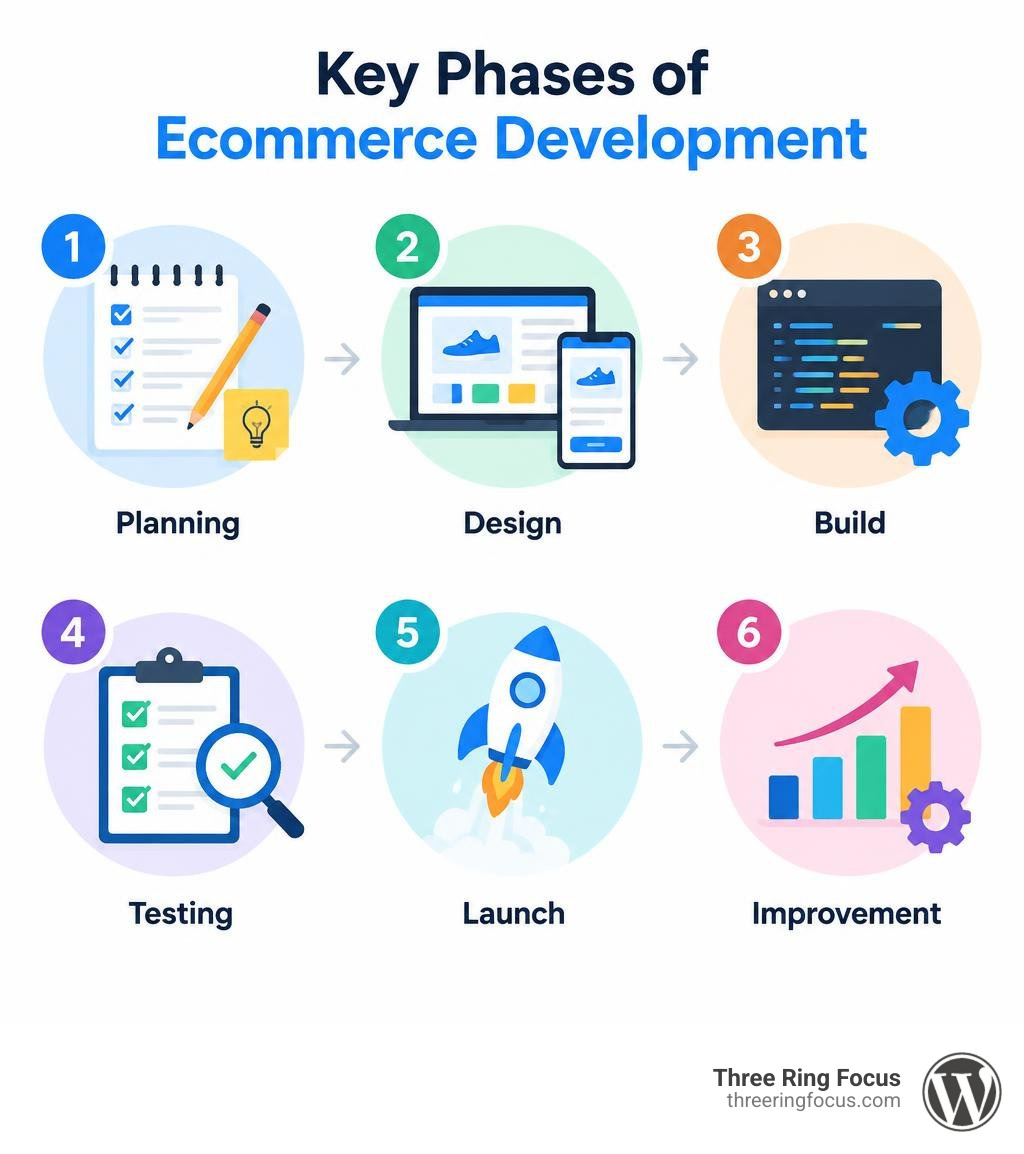
Ecommerce website development services terms explained:
Why Growing Brands Need Custom Ecommerce Website Development Services
When scaling an online retail business, the foundation beneath your digital storefront dictates how far you can expand. Many business owners initially rely on off-the-shelf site builders. While those tools offer a straightforward starting point, high-growth merchants quickly bump up against structural limitations. Evaluating custom web design vs online templates reveals that off-the-shelf themes carry hidden liabilities: code bloat, inflexible user journeys, and steep technical debt.
There is a massive difference between a pretty website and a successful one. A successful store doesn’t just display product imagery; it orchestrates high-speed transactions, provides watertight payment security, and integrates seamlessly with your downstream operational software. Professional ecommerce website development services engineer tailored storefront architectures that prioritize conversion rates, brand identity, and rigorous PCI-DSS compliance from day one.
Limitations of Pre-Made Online Store Templates
Pre-built ecommerce themes are designed to cater to everyone, which means they are optimized for no one in particular. To cover every possible use case, commercial theme marketplaces bundle hundreds of redundant scripts, oversized style sheets, and generic styling frameworks.
Common bottlenecks associated with generic templates include:
- Bloated codebases and slow database queries: Extraneous JavaScript libraries drag down page load speeds, directly increasing bounce rates.
- Plug-in conflicts and security vulnerabilities: Adding third-party plugins for every minor feature creates dependency chains that frequently break during core software updates.
- Rigid layout constraints: Attempting to customize checkout steps or faceted product filters often results in broken responsive breakpoints.
- Compromised first impressions: Cookie-cutter layouts make your brand blend in with thousands of competitors, committing classic mistakes that kill your website’s first impression.
- Vendor lock-in and multi-store roadblocks: Scaling into multi-currency, wholesale portals, or multi-warehouse inventories becomes difficult or impossible within basic template constraints.
Tailoring Custom Ecommerce Website Development Services for High-Volume Scaling
Bespoke ecommerce engineering eliminates unnecessary features, delivering clean, purposeful code built around your specific catalog workflows. When planning smart business website development strategies, custom architecture ensures your site can handle high concurrency during flash sales, seasonal shopping rushes, and product drops without server degradation.
| Architectural Feature | Pre-Made Online Store Templates | Custom Ecommerce Engineering |
|---|---|---|
| Page Load Speed | Slower due to unused theme scripts and plugin bloat | Highly optimized; lean assets, edge caching, sub-1.5s LCP |
| Checkout Flow | Standardized, rigid steps with limited gateway flexibility | Tailored one-page or multi-step checkout with custom logic |
| Backend Integrations | Basic third-party app connectors prone to sync errors | Direct API event-driven webhooks for ERP, CRM, and OMS |
| Security & Compliance | Relies entirely on external plugin maintenance | Isolated payment tokenization (PCI SAQ-A), automated audits |
| Scalability & Concurrency | Slows down or crashes under heavy traffic surges | Cloud-native elastic infrastructure tested for 10x traffic spikes |
Choosing the Right Platform for Your Enterprise Needs
Selecting the engine for your online store is one of the most critical operational decisions you will make. Weighing CMS website design vs custom code requires analyzing your product catalog size, transaction volume, internal technical resources, and overall total cost of ownership.
| Platform / Architecture | Ideal Business Fit | Catalog Complexity | Customization Level | Typical Build Timeline |
|---|---|---|---|---|
| Shopify Plus | Fast-growing D2C & mid-market retail | Moderate to High | High (via APIs & Theme Customization) | 6 to 12 weeks |
| BigCommerce | B2B, wholesale, and multi-channel sellers | High | High (robust native features & open APIs) | 8 to 14 weeks |
| Adobe Commerce | Large enterprise retail & complex global B2B | Very High | Maximum (full source code control) | 4 to 9 months |
| WooCommerce | Content-driven brands & SMB retail | Low to Moderate | High (open-source WordPress ecosystem) | 4 to 8 weeks |
| Headless / Composable | Enterprise brands needing extreme speed & UX | Very High | Total control over frontend presentation | 3 to 6 months |
Shopify Plus and BigCommerce for Agile Growth
For brands seeking rapid deployment without the overhead of server management, enterprise SaaS platforms like Shopify Plus and BigCommerce are powerful solutions. These hosted environments take care of PCI compliance, server patching, and core infrastructure maintenance, allowing you to focus on merchandising and marketing.
Shopify Plus offers hosted reliability, native multi-currency functionality, and extensive developer APIs. BigCommerce provides rich out-of-the-box B2B features, such as custom price lists, customer group hierarchies, and quote-generation workflows, making it ideal for merchants operating hybrid direct-to-consumer and wholesale models.
Adobe Commerce and WooCommerce for Deep Customization
Open-source commerce platforms provide complete ownership and control over your database schemas, backend logic, and hosting environments. Adobe Commerce (formerly Magento) remains a staple for complex multi-brand enterprises requiring localized catalogs across dozens of countries, intricate ERP integrations, and custom database tables.
WooCommerce offers exceptional flexibility for content-heavy brands already powered by WordPress. It allows businesses to pair rich editorial content with an online storefront. However, managing open-source platforms requires experienced engineering to ensure database queries remain performant and security patches are applied systematically. This is why why professional web designers and developers matter when structuring self-hosted infrastructure.
When to Invest in Headless and Composable Commerce Architecture
Headless commerce completely decouples your customer-facing frontend user interface from the underlying backend commerce engine. Communicating through high-speed GraphQL and REST APIs, modern frontends built with modern frameworks can deliver sub-1.5s Largest Contentful Paint (LCP) speeds.
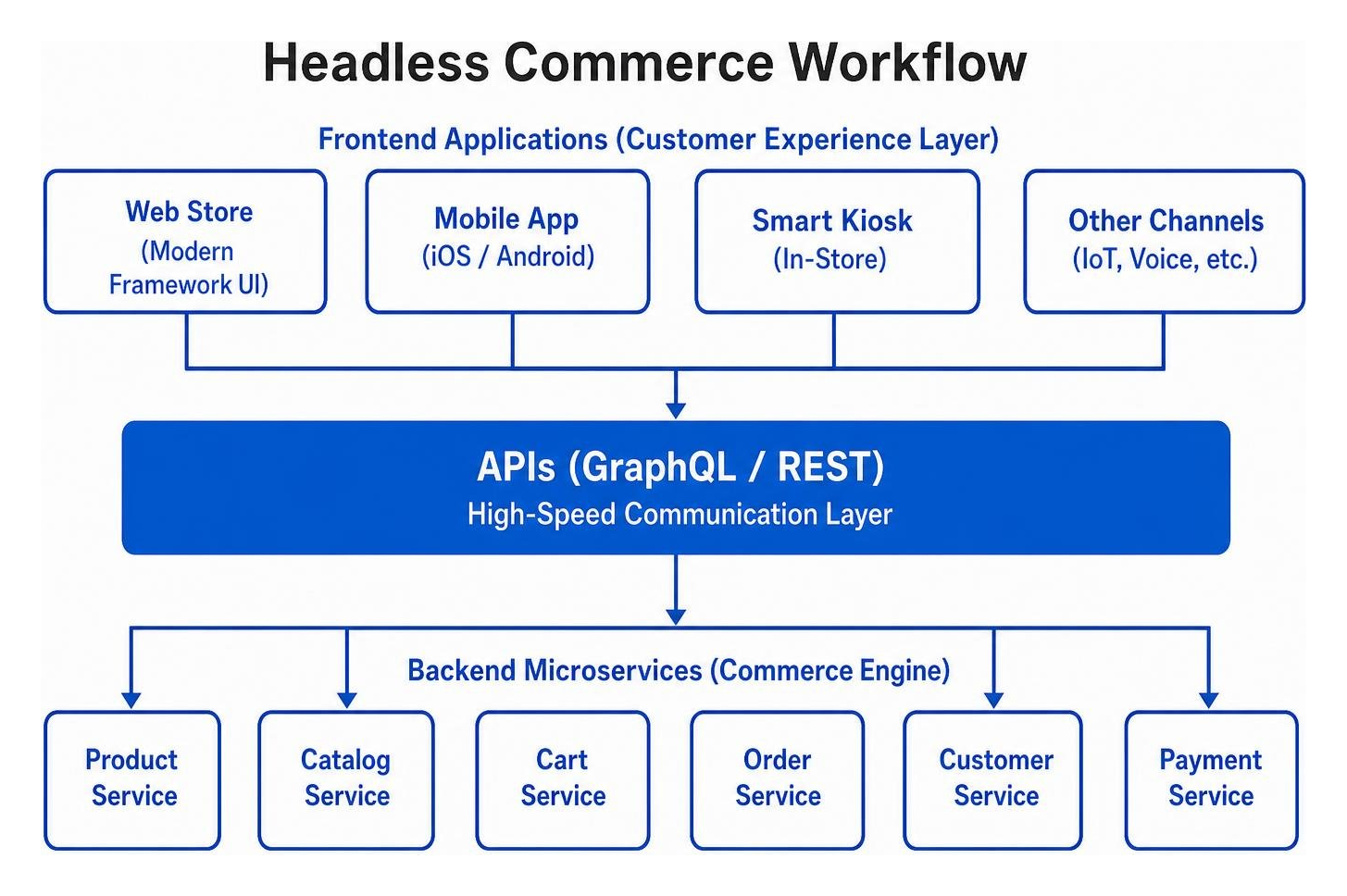
A composable approach is best when your store requires:
- True omnichannel content delivery across web, native mobile apps, smart kiosks, and IoT devices.
- Ultra-fast mobile performance that standard theme liquid templates cannot achieve.
- Total freedom to integrate modular best-of-breed software solutions (such as dedicated search engines, headless CMS platforms, and independent order management systems) without platform vendor lock-in.
Core Architectural Features for High-Converting Ecommerce Storefronts
High-converting digital commerce requires combining aesthetic design with robust technical performance. A successful online store must be engineered to remove friction at every stage of the customer journey, from initial landing page discovery to post-purchase confirmation.
Prioritizing improving website speed and performance is vital for conversion rates. Modern shoppers expect instant interactions. Because over half of all digital transactions occur on smartphones, mobile-friendly websites are non-negotiable. Adhering to universal web accessibility standards ensures that every customer, regardless of ability or assistive device, can navigate catalogs and complete purchases smoothly.
Optimizing Checkout Flows and Core Web Vitals
Cart abandonment often stems from friction during the final steps of checkout. Professional development teams focus on:
- Accelerated Digital Wallets: Integrating one-click payment flows like Apple Pay, Google Pay, and Shop Pay.
- Layout Stability (CLS < 0.05): Reserving explicit dimension containers for banners, product media, and third-party widgets so screen elements don’t shift unexpectedly while loading.
- Interaction to Next Paint (INP < 200ms): Using component code-splitting and deferred script hydration so interactive elements respond instantly to user clicks and taps.
- Secure Tokenization: Implementing hosted fields and direct gateway tokenization (such as Stripe Elements) so sensitive credit card numbers never touch your primary web servers.
Integrating Critical Enterprise Systems (ERP, CRM, OMS, and PIM)
As your sales volume increases, manual data entry across disconnected systems becomes a major operational liability. Modern custom development connects your digital storefront directly to your broader operational ecosystem:
- ERP Systems (SAP, NetSuite, Dynamics, QuickBooks): Synchronizes general ledger accounting, accounts payable/receivable, and vendor purchasing.
- Product Information Management (PIM): Serves as the single source of truth for technical specifications, multi-language descriptions, and high-resolution digital assets.
- Order Management Systems (OMS): Automates fulfillment routing across multiple third-party logistics providers, brick-and-mortar stores, and regional warehouses.
- Customer Relationship Management (CRM): Unifies customer purchase histories, loyalty reward tiers, and automated support ticketing.
Using asynchronous webhook queues ensures that enterprise back-office data synchronization happens smoothly in the background without slowing down storefront browsing speeds.
Integrating AI and Machine Learning into Ecommerce Website Development Services
Artificial intelligence and automation have moved from experimental concepts to essential tools for high-performing storefronts. Tailored ecommerce development allows brands to integrate AI capabilities directly into customer journeys and backend operations:
- Personalized Product Recommendations: Machine learning models analyze live session behavior, past purchasing habits, and real-time inventory to display relevant cross-sells and upsells.
- Predictive Faceted Search: Intelligent search engines understand user intent, correct misspellings, and prioritize high-margin or trending items in search results.
- Automated Catalog Tagging: AI services scan incoming product assets to automatically generate descriptive metadata, alt text, and taxonomical categories.
- Dynamic Pricing Algorithms: Automated systems adjust pricing based on real-time demand, competitor benchmarks, and localized inventory levels.
- AI-Powered Customer Support Agents: Conversational AI models resolve order status inquiries, handle return requests, and assist with sizing questions around the clock.
Navigating Seamless Platform Migrations Without Losing SEO Equity
Replatforming an established ecommerce store carries significant technical risks if executed improperly. Deciding when to redesign your website or transition to a more powerful engine requires careful planning to prevent sudden organic traffic drops, broken inbound links, and frustrated return customers.
A poorly handled migration can lead to serious search indexing problems, highlighting why your website is not showing up on Google. Following established Google site move guidelines is vital for protecting your hard-earned domain authority and search visibility.
Complete 301 Redirect Mapping and URL Architecture Preservation
Every legacy URL that generates traffic, ranks for keywords, or holds backlinks must be mapped and redirected before launch:
- One-to-One 301 Redirection: Directs legacy product, category, and blog URLs to their exact corresponding destinations on the new platform.
- Preserving Structured Metadata: Migrates existing meta titles, descriptions, OpenGraph tags, and Schema.org product structured data (including reviews, pricing, and availability tags).
- Canonical URL Rules: Ensures consistent URL hierarchies to prevent duplicate content indexing across faceted filter pages.
End-to-End Data Transfer and Operational Testing
Moving catalog and transaction records requires strict data integrity protocols:
- Customer Account Migration: Securely transferring customer profiles, saved addresses, tax exemption certificates, and purchase histories.
- Order History Synchronization: Preserving historical transaction records for financial auditing and seamless customer re-orders.
- Quality Assurance and Staging Audits: Testing all payment gateways, tax calculation rules, shipping matrix tables, and dynamic email triggers in a staging environment.
- Zero-Downtime DNS Cutover: Executing the final DNS cutover during lowest-traffic periods with automated rollback protocols ready if unexpected issues arise.
The Lifecycle of Ecommerce Development: Timelines, Sprints, and Ongoing Maintenance
Building an enterprise-ready ecommerce platform is a structured, collaborative engineering process. Experienced development agencies work in agile sprints backed by clear functional scopes, live backlog tracking, and rigorous quality assurance benchmarks.
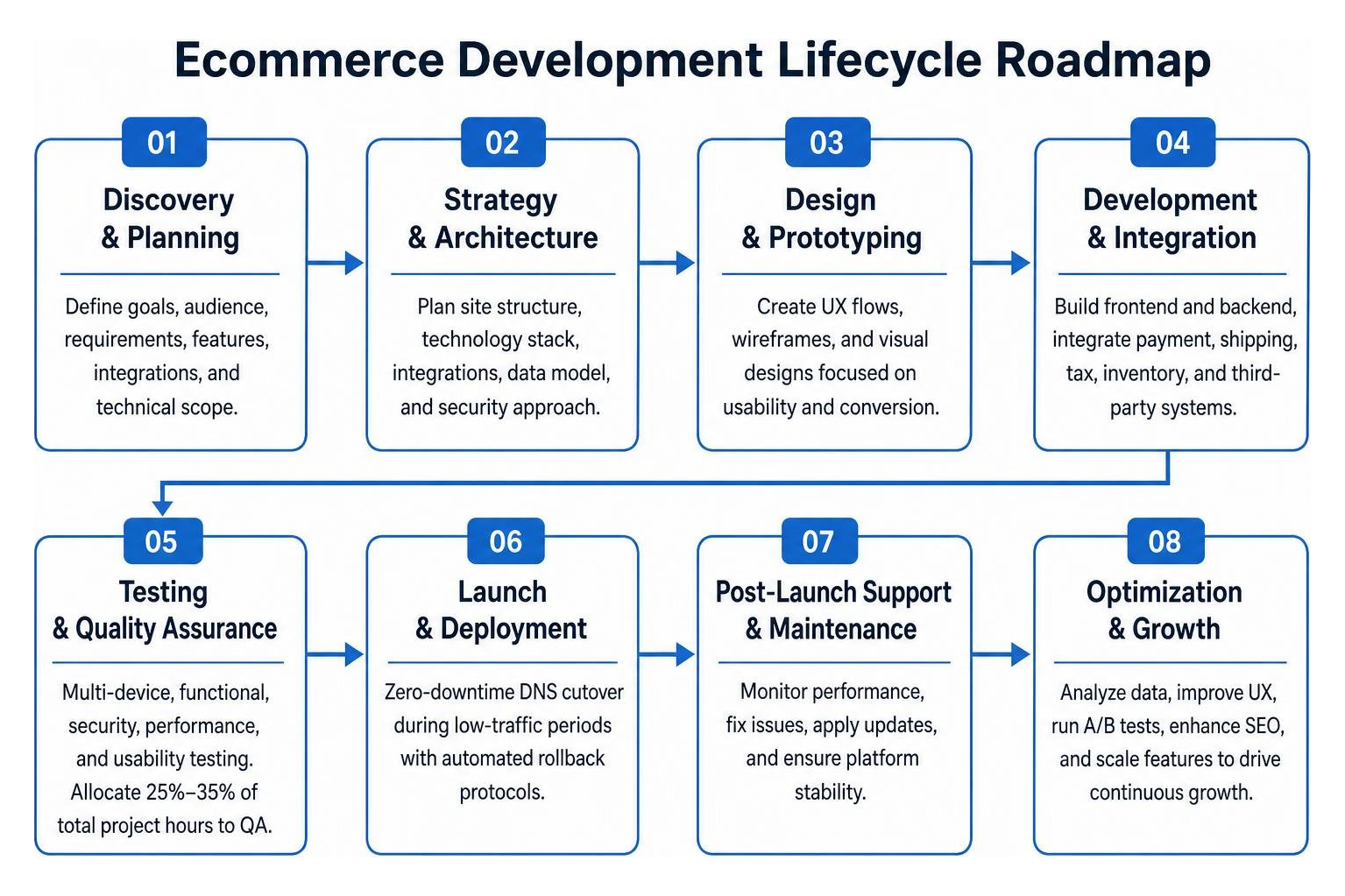
Treating Quality Assurance (QA) as an integral phase—allocating 25% to 35% of total project hours to multi-device and automated functional testing—prevents critical bugs from reaching live production environments.
Typical Ecommerce Development Timelines and Cost Factors
Project timelines vary based on architectural complexity, third-party system connections, and custom frontend requirements:
- Standard SaaS Store Builds (4 to 8 Weeks): Ideal for streamlined direct-to-consumer stores using core platform features with tailored styling and standard app integrations.
- Mid-Market & Hybrid B2B Storefronts (8 to 14 Weeks): Involves custom theme development, ERP connectors, tiered wholesale pricing, and advanced product filtering.
- Enterprise Headless & Deep Custom Builds (3 to 6 Months): Comprehensive decoupled architectures, multi-region localizations, custom microservices, and bespoke business logic.
Key cost factors include the depth of custom backend logic, the number of legacy data records being migrated, and the level of custom API middleware required to connect your enterprise software stack.
Post-Launch Optimization and Proactive Storefront Support
Launching your ecommerce store is just the beginning. Without structured upkeep, software dependencies decay, security risks increase, and conversion rates drop over time. Understanding what happens without continuous website maintenance highlights why proactive system monitoring is essential.
Implementing proactive website maintenance strategies protects your online store through:
- Continuous Conversion Rate Optimization (CRO): Running iterative A/B tests on product detail pages, cart drawers, and call-to-action buttons to maximize average order value (AOV) and reduce abandonment.
- Security & Dependency Patching: Applying critical security updates, reviewing third-party API tokens, and running automated vulnerability scans.
- Database & Asset Optimization: Clearing transient database records, optimizing media delivery via CDNs, and maintaining fast server response times.
- 24/7 Infrastructure Monitoring: Proactive server and uptime monitoring to ensure your storefront handles unexpected traffic surges effortlessly.
Frequently Asked Questions About Ecommerce Website Development Services
How long does it take to develop a custom ecommerce website?
Development timelines depend entirely on the scope and complexity of your build. A streamlined store built on an enterprise SaaS platform can launch in 4 to 8 weeks. In contrast, complex mid-market stores, high-volume B2B portals, or headless builds typically require 3 to 6 months. This timeline includes comprehensive discovery workshops, custom UI/UX design sprints, custom backend coding, ERP integrations, quality assurance testing, and data migration.
How do custom ecommerce builds protect search engine rankings during migration?
Experienced developers protect your organic search equity through meticulous preparation. This involves generating comprehensive one-to-one 301 redirect maps for all legacy URLs, preserving existing metadata and heading hierarchies, carrying over structured Schema.org markup, and conducting pre- and post-launch crawl audits. Executing the migration during low-traffic windows prevents search engine bots from encountering crawl errors.
What are the main benefits of integrating AI into an ecommerce platform?
Integrating AI tools directly into your ecommerce architecture improves both user experience and operational efficiency. Customer-facing benefits include real-time personalized product recommendations, smart predictive search, dynamic pricing, and 24/7 conversational customer support. Operationally, AI streamlines backend catalog management through automated product tagging, demand forecasting, and automated fraud detection during checkout.
Conclusion
Scaling a modern digital brand requires more than an attractive storefront—it demands a fast, secure, and flexible operational engine. Investing in tailored ecommerce website development services provides the technical foundation your business needs to reduce cart abandonment, automate back-office workflows, and handle rapid sales growth without disruptions.
Whether you are launching an innovative direct-to-consumer brand, building a complex B2B wholesale portal, or migrating an established store away from legacy constraints, working with a dedicated partner ensures long-term return on investment. If you are ready to take your online sales to the next level, partner with an expert web design and digital growth agency to engineer an ecommerce storefront built for measurable, sustainable success.