How to Choose Design and Printing Services on a Budget
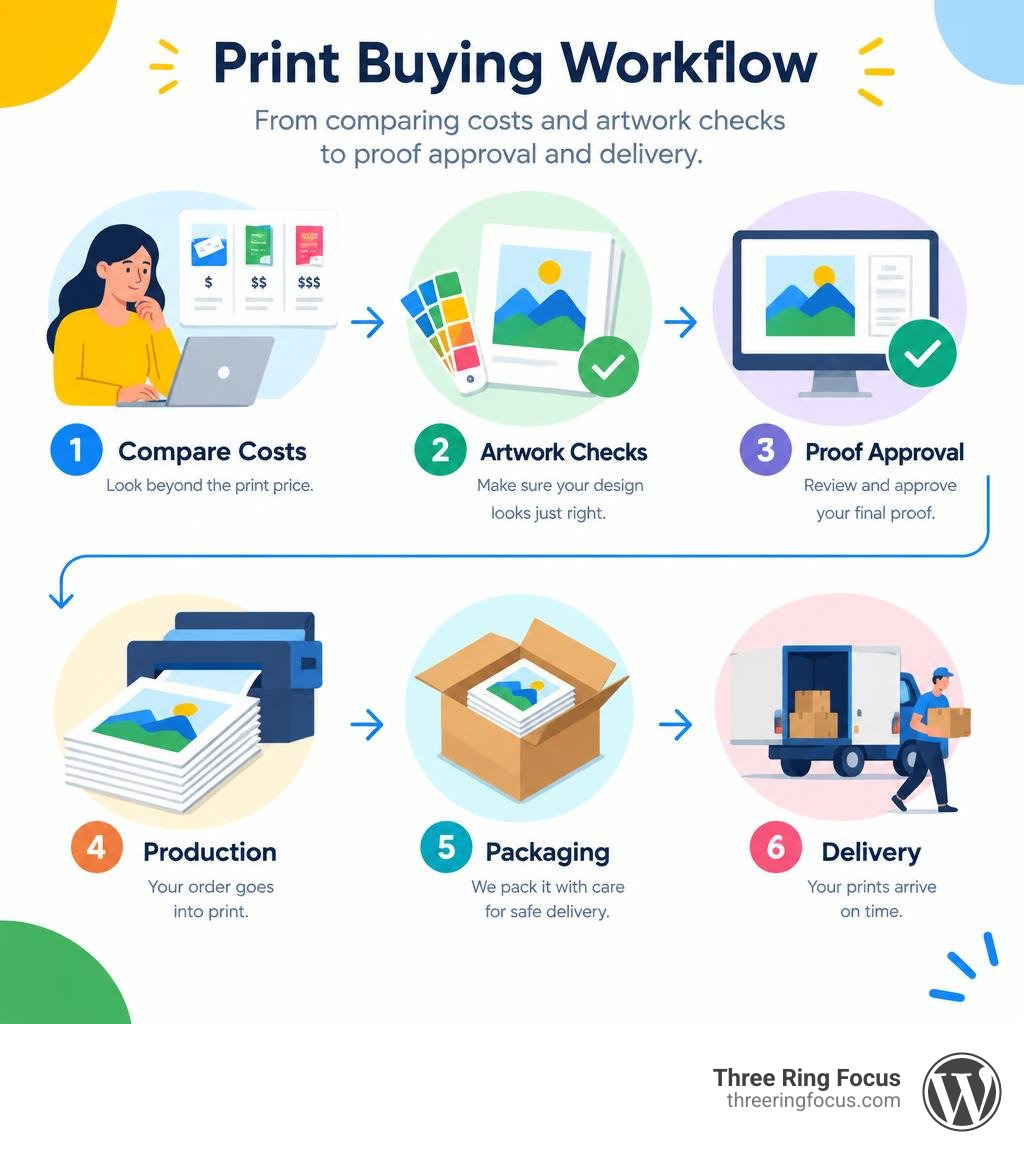
Compare the full cost, not just the print price. Choose the products you need, then check each service’s design tools, paper or material options, proofing process, and delivery date. For a small business, matching your print designs to your website and other marketing can also help your brand look consistent without paying to redesign every item. The printing industry has shifted toward online ordering and automated prepress, so understanding how modern workflows affect turnaround and quality can help you avoid costly surprises.
I’m Luke Wherry, Marketing Director at Three Ring Focus, where I’ve worked on branding and marketing for local businesses since 2009. I’ll show you how to weigh design and printing services so you can spend where quality matters and avoid costs you don’t need.
Essential Custom Print Products for Growing Businesses
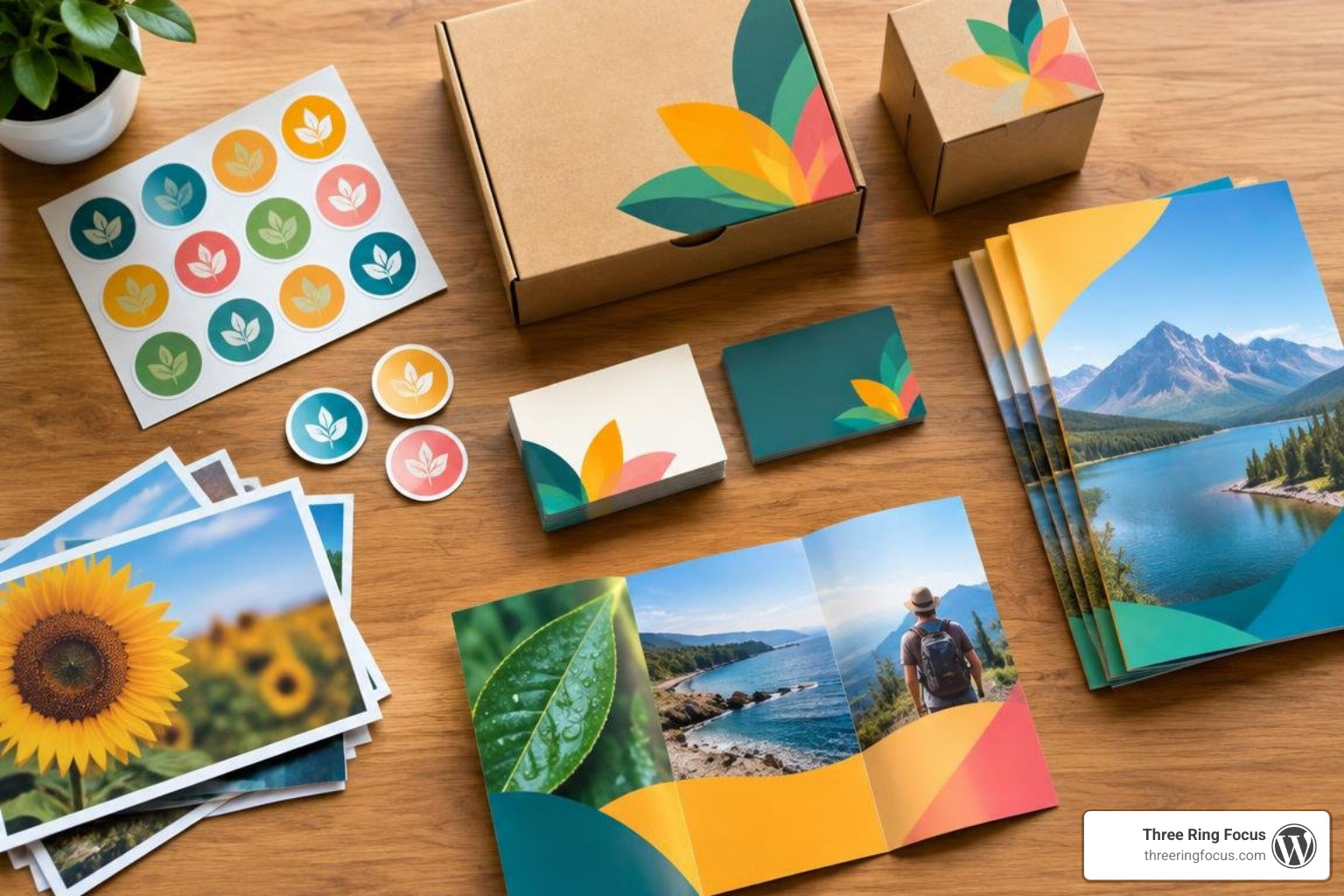
Physical marketing remains one of the most reliable ways to build credibility in your local market. When potential clients hold a thick, beautifully finished business card or receive an eye-catching direct mailer, it creates a tactile connection that digital ads simply cannot replicate. Today, modern print catalogs offer well over 150 unique print products with thousands of customization options, allowing businesses of all sizes to craft cohesive brand collateral.
Whether you run a boutique retail shop, a bustling restaurant, or a regional service company, selecting the right mix of collateral is critical. Foundational print marketing typically includes:
- Business Stationery & Cards: Premium paper stocks, foil accents, and raised spot UV finishes that make a lasting first impression.
- Product Packaging & Pouches: Stand-up pouches, custom folding cartons, and branded packing tape that turn simple order fulfillments into memorable unboxing experiences.
- Sales & Promotional Collateral: Booklets, multi-page catalogs, rack cards, presentation folders, and durable promotional items that keep your company top-of-mind.
- Event & Facility Displays: Table runners, retractable pop-ups, outdoor vinyl banners, and directional signs for community expos and trade shows.
Selecting the right product format requires understanding how each item functions in everyday operations. A common area of confusion involves adhesive branding—specifically when to choose sheet labels, roll labels, or custom stickers.
Sheet Labels vs. Roll Labels vs. Custom Stickers
While sheet labels, roll labels, and individual stickers might feature identical artwork, their physical configurations serve vastly different production and distribution needs.
- Sheet Labels: Distributed on standard flat sheets (such as 8.5″ x 11″), sheet labels are designed for low-volume hand application, seasonal product runs, or testing new container styles. They are budget-friendly for small test batches because they do not require dedicated dispensing machinery.
- Roll Labels: Wound tightly around an inner cardboard core, roll labels are engineered for medium- to high-volume production. They fit into automatic label applicators or semi-manual dispensers, dramatically speeding up manufacturing lines while preventing misalignment on bottles, jars, and boxes.
- Custom Stickers (Die-Cut & Kiss-Cut): Individually cut into custom shapes with contour backing, stickers are primarily promotional handouts. Customers stick them on laptops, water bottles, and vehicle bumpers, transforming everyday brand fans into mobile advocates.
| Adhesive Format | Optimal Volume | Application Method | Best Use Cases |
|---|---|---|---|
| Sheet Labels | Low (10 – 500 units) | Manual peeling by hand | Small-batch test products, seasonal goods, address labels |
| Roll Labels | Medium to High (250 – 10,000+ units) | Machine application or benchtop dispenser | Bottling, canning, packaged retail goods, shipping boxes |
| Custom Stickers | Low to High (50 – 5,000+ units) | Individual distribution | Swag bags, promotional giveaways, packaging seals |
Choosing the wrong format can lead to lost labor hours. Trying to peel 3,000 individual sheet labels by hand for a production run will cost far more in staff time than the price difference of ordering roll labels up front.
Large-Format Banners, Signage, and Direct Mail Postcards
Beyond small packaged goods, outdoor signage and direct-to-consumer print marketing play a major role in regional visibility. Integrating high-impact direct mail campaigns with local search strategies creates multiple touchpoints for nearby customers. For instance, pairing targeted neighborhood mailers with local digital visibility—as discussed in our guide on print marketing and local SEO—ensures that when a homeowner receives your promotional postcard in the mail, your company also dominates map listings when they look you up online.
Outdoor X-banner stands, weather-resistant car magnets, and vinyl yard signs ensure consistent visibility at job sites, community events, and retail storefronts. High-grade UV inks and waterproof vinyl materials keep these investments vibrant even after months of exposure to rain and sun.
Key Factors to Evaluate in Modern Design and Printing Services
Investing in custom print collateral requires balancing quality, turnaround speed, and cost. While budget-friendly pricing is always welcome, poor print calibration or flimsy paper stocks will damage your professional reputation. If you need dedicated help executing clean artwork, exploring professional graphic design services ensures your files meet strict press requirements before you commit your marketing budget.
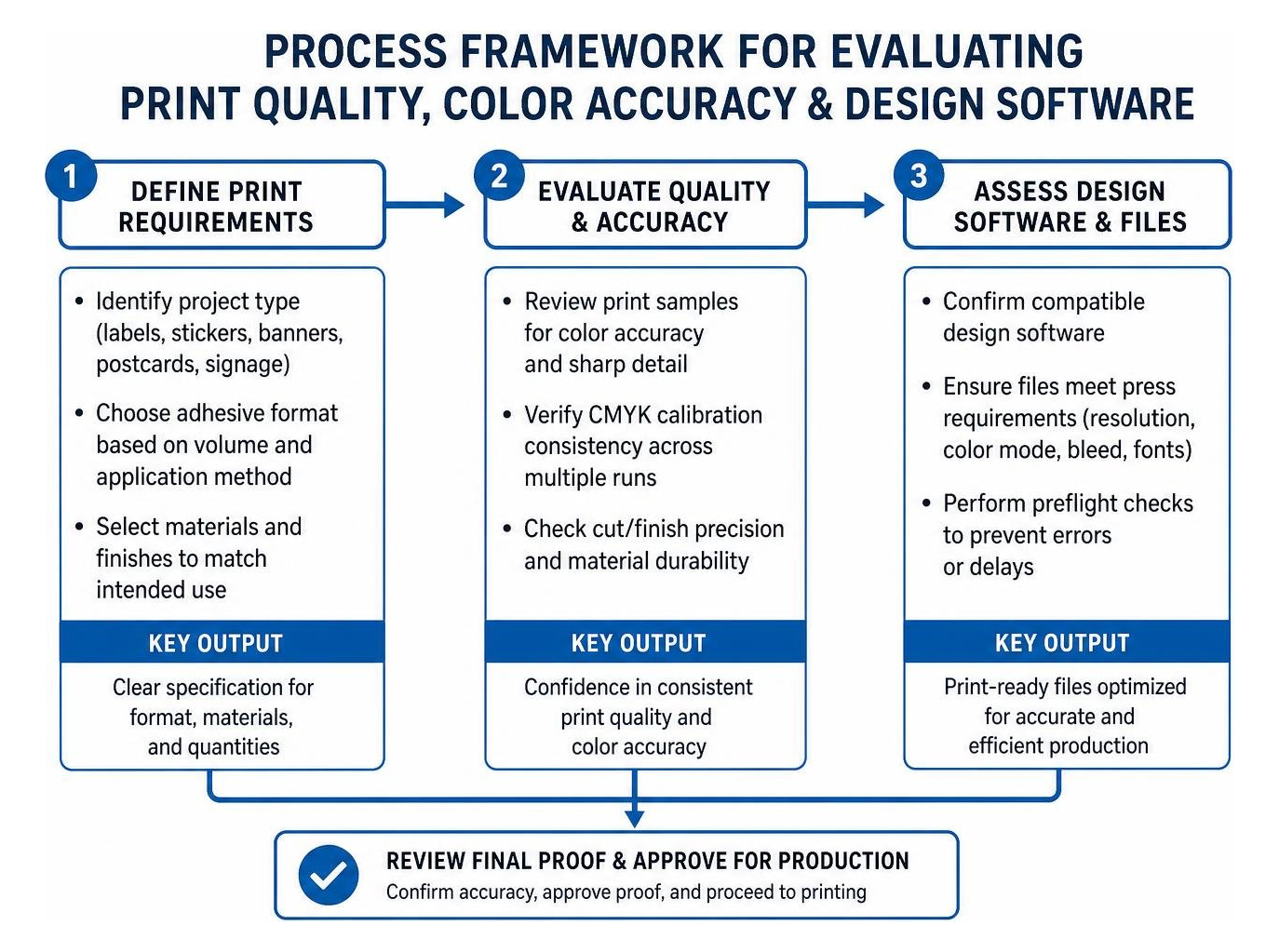
When vetting custom printing providers, focus on these critical benchmarks:
- Material Variety & Thickness: Verify whether the provider offers diverse paper weights (such as 14 pt., 16 pt., or 100 lb. gloss cover) and specialized textures like linen, velvet soft-touch, or durable synthetic vinyl.
- Color Reproduction Consistency: Commercial presses should maintain accurate CMYK calibration across multiple runs so that your second and third orders match your initial batch perfectly.
- Customer Guarantees: Look for companies offering 100% satisfaction guarantees that cover manufacturing defects, misaligned cuts, or transit damage with swift reprints.
Comparing Design Tools and Templates in Design and Printing Services
Most online print platforms now offer browser-based design editors alongside template libraries. These tools are convenient for basic layouts, but they have distinct technical trade-offs compared to professional vector design software.
Browser builders often rely on raster graphic imports, which can inadvertently drop below the crisp 300 DPI (dots per inch) threshold required for sharp commercial printing. Additionally, selecting preset color palettes inside a basic web editor does not always guarantee accurate CMYK ink separation on press. To build a memorable, unified visual presence across all print and web assets, you must understand the fundamentals of cohesive brand identity.
A key element of that identity is color consistency. Subtle differences between screen RGB colors and physical CMYK pigments can cause printed collateral to appear dull or off-brand if files are not converted properly. Taking time to review our insights on choosing the right colors for your brand will help ensure that the vibrant tones you approve on your monitor translate accurately to tangible inks and coated stocks.
Proofing and Artwork Checks in Design and Printing Services
Catching design and layout errors before a job hits the pressroom floor saves hundreds of dollars in reprint costs. The best providers offer automated or technician-assisted artwork checks at no additional charge.
When reviewing proofs, pay close attention to three essential technical zones:
- Bleed Margins: Your background colors and imagery should extend at least 0.125 inches (1/8″) beyond the final trim dimensions. This prevents unsightly white hairline borders if mechanical cutting blades shift slightly during high-speed trimming.
- Safety Trim Margins: Keep all critical text, phone numbers, and logos at least 0.125 inches inside the cut line to ensure no essential details are clipped.
- Digital 3D Previews vs. PDF Proofs: A digital 3D preview allows you to visualize how folded brochures, boxes, or stand-up pouches look when assembled. Meanwhile, a high-resolution, downloadable PDF proof allows you to inspect vector sharpness, typography spacing, and color separations at 100% scale. For specialized items like roll labels or flexible pouches, formal digital proof approval is often mandatory before production begins.
Turnaround Times, Shipping Tiers, and Cost Management

Production speed and shipping costs represent a major portion of your overall print expenditure. Many budget-friendly print prices become significantly more expensive once expedited shipping fees are added at checkout. Knowing how production turnaround schedules align with shipping tiers ensures you hit event deadlines without paying avoidable rush surcharges.
Turnaround Schedules and Shipping Speed Tiers
Production turnaround refers strictly to the time it takes to manufacture and package your order inside the printing facility; it does not include the days an order spends in transit with freight carriers. Standard production typically ranges between 2 and 4 business days for standard paper goods, while custom pouch manufacturing or complex structural packaging may require additional proofing and setup time.
| Shipping Tier | Average Transit Window | Best Application | Budget Consideration |
|---|---|---|---|
| Economy / Standard | 5 – 7 Business Days | Planned restocking, seasonal collateral | Most economical; often free when order exceeds $75 |
| Priority | 3 – 4 Business Days | Upcoming promotions, regional tradeshows | Moderate surcharge for guaranteed delivery window |
| Rush | 2 – 3 Business Days | Emergency stock shortages, sudden events | Premium pricing; best reserved for urgent needs |
To maximize savings, plan your collateral needs 3 to 4 weeks before trade shows, conferences, or retail launches. This buffer lets you use standard shipping tiers and take full advantage of free shipping thresholds (frequently offered on orders over $75).
Sample Packs, Volume Discounts, and Order Change Policies
Before committing to large production volumes, take advantage of sample programs and customer protection policies:
- Material Sample Packs: Many commercial printers provide free sample kits containing physical swatches of paper weights, specialty finishes (matte, soft-touch, high-gloss UV), and adhesive vinyls. While these packs contain pre-printed material examples rather than your custom artwork, they let you feel the stock and test durability firsthand.
- Volume Price Breaks: Print manufacturing involves fixed mechanical setup costs. As a result, ordering 1,000 postcards or business cards often costs only marginally more than ordering 250. Consolidating orders across multiple departments or planning quarterly marketing collateral in a single print run can lower your unit cost significantly.
- Order Change Windows: Due to automated prepress workflows, standard cancellation or artwork modification windows are typically limited to 30 minutes following checkout. Once an order passes prepress validation and enters the automated print queue, changes or cancellations may incur plating fees or become impossible. Maintaining an active account profile allows you to access past order histories and initiate fast, error-free reorders of previously approved designs.
Frequently Asked Questions about Custom Printing
How do I know if my artwork is print-ready before ordering?
Artwork is considered print-ready when it meets four core technical standards:
- Resolution: All embedded raster images must be at least 300 DPI at 100% of their final physical print size to prevent blurriness or pixelation.
- Color Mode: Files should be built and exported in CMYK (Cyan, Magenta, Yellow, Key/Black) rather than digital RGB (Red, Green, Blue) to prevent unexpected color shifts on press.
- Bleeds and Safety Margins: Include a standard 0.125-inch bleed around all outer edges, and keep critical text within the inner safety zone.
- Font Outlines: Convert all text typography into vector paths/outlines, or embed font files directly into high-resolution, press-quality PDFs (such as PDF/X-1a standards).
Can I request physical material samples before placing a full order?
Yes. Leading commercial printing services offer free material sample packs that include swatches of varying paper stocks, laminate finishes, synthetic vinyls, and label adhesives. While custom one-off physical proofs of your exact design are generally reserved for specialized high-volume orders (such as custom roll labels), requesting a free material pack allows you to evaluate paper weights, stiffness, and tactile coatings before making a substantial financial commitment.
What is the difference between custom professional design and online DIY templates?
While browser-based templates offer a quick fix, they are publicly accessible to thousands of competing businesses, making it difficult to establish a unique identity. Furthermore, DIY template generators often produce flattened files that cannot scale cleanly to large-format signage or specialized packaging dies.
Custom professional design delivers original vector-based assets tailored specifically to your audience. When investing in foundational elements like professional logo design, an experienced agency builds a cohesive visual language—including typography hierarchies, exact Pantone spot color formulas, and master vector files. These assets scale seamlessly from an embroidered staff shirt to a 20-foot outdoor highway billboard without losing clarity or visual balance.
Conclusion
Finding high-quality custom print collateral without exceeding your marketing budget comes down to smart planning, careful file preparation, and selecting the right product formats for your specific operational needs. By ordering material samples in advance, taking advantage of bulk volume discounts, and verifying bleed margins through digital proofs, you can confidently produce professional marketing collateral that elevates your business.
At Three Ring Focus, we believe in a unified, single-source marketing strategy that bridges physical print collateral with a strong digital presence. Exploring the appeal of print design in a digital world reveals how tangible marketing materials build memorable trust and drive measurable engagement for local businesses. Contact our team today to streamline your design, web, and print marketing under one expert roof.